



Patients with larger or stronger masseters may require more units, while those with smaller muscles or more subtle cosmetic goals may need a more conservative treatment. The number of units also depends on why Masseter Botox is being performed. Someone seeking a slimmer, less square jawline may have a different treatment plan from someone with powerful jaw clenching or bruxism-related muscle activity. Facial symmetry matters as well, because one masseter can be larger or stronger than the other and may require a different dose.
Current clinical research supports this individualized approach. Studies of onabotulinumtoxinA for masseter muscle prominence have evaluated total bilateral doses including 24, 48, 72, and 96 units, demonstrating that there is no single dose that should automatically be used for every patient. At Dr. Syra Aesthetics and Longevity Institute, we do not determine Masseter Botox dosage from a fixed unit chart alone. Dr. Syra Hanif examines the lower face at rest, evaluates the masseters during clenching, compares muscle size and strength on both sides, considers facial proportions and skin support, and discusses the patient’s cosmetic or functional goals before determining treatment. This individualized approach is especially important for patients considering Masseter Botox NYC treatment, where the goal is not simply to use the highest possible number of units, but to use an appropriate amount of Botox to reduce excessive masseter activity or prominence while preserving comfortable chewing, natural facial proportions, and balanced results.
Key Points:
- Most patients receive around 20–30 units of Botox per masseter, or approximately 40–60 units total when both sides are treated equally.
- There is no universal Masseter Botox dose. Muscle size, contraction strength, facial anatomy, asymmetry, treatment goals, and previous response can all influence the number of units needed.
- More Botox does not automatically mean better results. Excessive dosing may increase the risk of chewing weakness, unwanted facial slimming, hollowing, or asymmetry.
- Jaw slimming and functional treatment are different goals. The amount needed for cosmetic masseter reduction may differ from treatment intended to reduce strong clenching or bruxism-related muscle activity.
- Per-side and total units should not be confused. For example, 60 units total usually means 30 units per masseter when both sides are treated equally.
- Botox, Dysport, Xeomin, and Jeuveau units are product-specific and should not be directly compared or converted unit-for-unit.
- A personalized Masseter Botox NYC treatment plan should be based on direct muscle assessment, facial balance, and the patient’s specific cosmetic or functional goals.
How many units of Botox are needed for masseters?
Most patients receive around 20–30 units of Botox per masseter, or approximately 40–60 units total for both sides. However, the exact amount can vary based on masseter size, muscle strength, facial anatomy, treatment goals, and whether Botox is being used for jaw slimming, clenching, or bruxism. People with larger or stronger masseter muscles may need 30–40 units or more per side, while some first-time or smaller-muscle patients may respond to lower amounts. Recent clinical studies of onabotulinumtoxinA have also evaluated total bilateral doses such as 48 units and 72 units, showing that effective dosing can vary considerably between patients. The goal is not to use the highest number of units, but to use the lowest appropriate dose that achieves the desired result while preserving normal chewing function and facial balance.
At Dr. Syra Aesthetics and Longevity Institute, Masseter Botox dosing is individualized rather than fixed. Dr. Syra Hanif evaluates masseter muscle size, symmetry, and functional activity to determine the appropriate per-side dosing, ensuring effective muscle relaxation while preserving normal mastication.
How Many Units For Masseter Botox Per Side?
Masseter Botox is dosed 20–30 units per side, which equals 40–60 units total. Clarifying this distinction is important, as treatment is administered bilaterally and unit recommendations are commonly discussed on a per-muscle basis. For patients with larger or hypertrophic masseter muscles, dosing often increases to 30–40 units per side (60–80 units total) to adequately weaken the stronger jaw muscle. For average cosmetic jaw slimming, the usual dose is 20–25 units per side (40–50 units total), sufficient to reduce lower-face width without affecting chewing. When botulinum toxin is used for TMJ dysfunction or bruxism, dosing commonly ranges from 25–40 units per side (50–80 units total), as therapeutic outcomes depend on reducing clenching force and sustained muscle activity.
Is 20, 30, 40, 50, or 60 Units Per Side Too Much for Masseter Botox?
For a first-time patient, masseter Botox is started at a lower initial dose of 15–20 units per side (30–40 units total). This approach is used to assess individual muscle response, avoid excessive weakening, and preserve normal chewing function. After 2–4 weeks, the treatment response is reassessed. If muscle reduction, jaw contour change, or symptom relief is insufficient, the dose can be adjusted upward in a controlled manner. Subsequent treatments commonly increase toward standard dosing ranges of 20–30 units per side, depending on muscle size, symmetry, and treatment goals.
This start-low, reassess, and adjust strategy allows for safe titration, minimizes adverse effects such as chewing fatigue, and provides individualized dosing over time.
What Factors Determine How Many Masseter Botox Units You Need?
The number of Masseter Botox units you need depends mainly on muscle size, contraction strength, facial anatomy, symmetry, treatment goals, previous response, and the specific botulinum toxin product being used. Larger or more powerful masseter muscles may require more units than smaller muscles, while patients seeking subtle jaw slimming may need a more conservative approach than those with significant clenching or bruxism-related muscle activity.
Facial structure also plays an important role because jaw width can come from a combination of muscle, bone, facial fat, and skin laxity. One side of the jaw may also be stronger or more prominent than the other, which means equal dosing is not always necessary. Previous treatment response can further guide future dosing by showing how much muscle relaxation, facial slimming, chewing comfort, and treatment duration occurred with an earlier dose.
At Dr. Syra Aesthetics and Longevity Institute, Dr. Syra Hanif evaluates the masseters at rest and during clenching, compares both sides, considers facial proportions and treatment goals, and then determines an individualized dose rather than relying on a fixed unit chart.
Botox vs Dysport vs Xeomin vs Jeuveau Units for Masseters
Masseter Botox dosing varies by product because units are not interchangeable. Dysport requires a higher numeric dose, while Jeuveau and Xeomin are dosed similarly to Botox. In all cases, dosing is calculated per side and adjusted based on masseter size and whether the treatment goal is cosmetic slimming or functional relief.
Dysport is dosed at 50–75 units per side (100–150 units total), reflecting its higher unit conversion compared to other neuromodulators.
Jeuveau is commonly administered at 20–30 units per side (40–60 units total), as its unit potency aligns closely with Botox.
Xeomin is also dosed at 20–30 units per side (40–60 units total), with dosing based on muscle size and treatment intent rather than formulation differences.
How Many Units Of Dysport Are Needed For Masseter?
For masseter treatment, Dysport is dosed at 50–75 units per side (100–150 units total). Dysport units are not interchangeable with Botox units and generally require a higher numeric dose due to different potency and diffusion characteristics. Dosing is adjusted based on muscle size and functional needs such as bruxism.
How Many Units Of Jeuveau Are Needed For Masseters?
Jeuveau dosing for the masseter usually mirrors Botox, at 20–30 units per side (40–60 units total). Jeuveau has a similar unit-to-unit potency to Botox, making conversion straightforward. Higher doses may be used for hypertrophic muscles or functional indications.
How Many Units Of Xeomin Are Needed For Masseter?
Xeomin is also dosed similarly to Botox, with dosing at 20–30 units per side (40–60 units total). Because Xeomin contains only the active neurotoxin without accessory proteins, dosing is based on muscle size and treatment intent rather than brand-specific adjustments.
What Happens if Too Few Units Are Used?
If the Masseter Botox dose is insufficient for the patient’s muscle strength or treatment goal, the result may be incomplete rather than harmful.
Possible signs of inadequate treatment can include:
- continued strong clenching,
- minimal reduction in jaw tension,
- little change in facial width,
- limited muscle relaxation,
- or persistent asymmetry.
However, Botox results should not be judged immediately.
We allow enough time for the treatment response to develop before deciding whether additional treatment or a different future dose is appropriate.
An incomplete result may also occur because the patient’s lower-face width comes from bone or soft tissue rather than masseter muscle alone.
What Happens if Too Much Botox Is Used in the Masseter?
Too much Masseter Botox can produce excessive muscle weakness or unwanted changes in lower-face appearance.
Potential effects include:
- chewing fatigue,
- jaw weakness,
- excessive facial slimming,
- unwanted hollowing,
- asymmetry,
- or changes in the smile if nearby muscles are affected.
This is why we do not approach Masseter Botox with the idea that a higher dose automatically creates a better jawline.
Our goal is controlled muscle relaxation that preserves natural function and facial balance.
Can Masseter Botox Cause Jowls or Facial Hollowing?
Masseter Botox can make jowls or lower-face hollowing more noticeable in certain patients, particularly when substantial muscle volume is reduced in a face that already has limited soft-tissue support.
This does not happen to everyone.
The risk depends heavily on baseline anatomy.
Before recommending aggressive jaw slimming, we consider:
- existing skin laxity,
- facial fat volume,
- lower-face proportions,
- age-related volume changes,
- baseline masseter prominence,
- and the amount of narrowing the patient wants.
A patient with thick hypertrophic masseters and firm skin may be an excellent candidate for significant muscle reduction.
A patient with a naturally narrow face and pre-existing laxity may benefit from a more conservative approach.
Can Masseter Botox Affect the Jawbone?
Research into the long-term relationship between repeated botulinum toxin treatment and the jawbone is still developing, and current evidence does not support an overly simple yes-or-no conclusion. Some small human studies have reported changes in certain measurements of the mandible after botulinum toxin treatment of the chewing muscles. However, these studies have generally been limited by small sample sizes, different treatment protocols, and variable study quality.
More recent controlled research involving onabotulinumtoxinA for masseter prominence has been more reassuring during the period studied. One randomized Phase 2 study included CT and dental evaluations and reported no clinically relevant changes in the mandible or teeth during the study period. For patients considering repeated long-term Masseter Botox treatments, this is an appropriate topic to discuss during clinical consultation.
Where Do You Inject Masseter Botox?
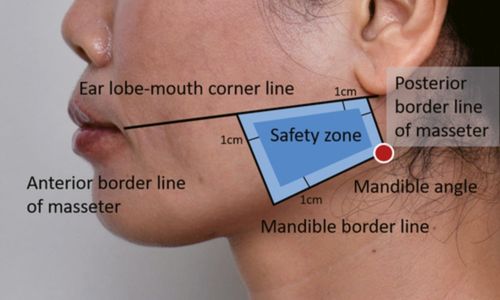
Masseter Botox is injected into the belly of the masseter muscle, located at the angle of the mandible. The muscle is identified by asking the patient to clench, allowing the injector to palpate the thickest portion of the muscle. Injection placement remains posterior to the oral commissure and avoids the upper masseter to reduce diffusion into nearby facial expression muscles. Proper depth and placement are essential to achieve effective muscle weakening and minimize adverse effects.
During examination, Dr. Syra asks the patient to clench.
This makes the muscle more prominent and allows Dr. Syra to assess:
- the muscle borders,
- the thickest area of the masseter,
- contraction strength,
- and differences between the two sides.
Placement matters because the masseter lies near muscles responsible for facial expression. Accurate anatomical placement helps keep the treatment focused within the intended muscle and reduces the chance of unwanted effects on surrounding muscles.
How We Determine Your Masseter Botox Dosage
We determine your Masseter Botox dose through a hands-on assessment rather than assigning the same number of units to every patient.
At Dr. Syra Aesthetics and Longevity Institute, Dr. Syra Hanif evaluates both the aesthetic appearance and functional activity of the jaw before recommending treatment.
1. We Clarify Your Treatment Goal
We first determine what you actually want to improve.
This may include:
- a square or wide jaw,
- visibly enlarged masseter muscles,
- facial asymmetry,
- jaw clenching,
- bruxism-related muscle activity,
- or a combination of cosmetic and functional concerns.
Knowing the intended result helps us determine how aggressively or conservatively the muscles should be treated.
2. We Examine Your Lower Face at Rest
We assess the jaw before asking you to clench.
This helps us evaluate:
- overall facial width,
- facial proportions,
- asymmetry,
- soft-tissue volume,
- jawline shape,
- skin support,
- and whether the width appears primarily muscular or skeletal.
This step is particularly important because not every wide jaw is caused by large masseters.
3. We Ask You to Clench
Clenching allows us to evaluate the masseter while it is actively contracting.
We can feel and observe:
- muscle prominence,
- muscle thickness,
- contraction strength,
- muscle boundaries,
- and differences between the two sides.
This hands-on assessment provides information that cannot be accurately determined from a standard dosing chart.
4. We Compare Both Masseters
The right and left sides are assessed separately.
If one masseter is larger or stronger, we can account for that difference when planning treatment rather than automatically using identical dosing.
5. We Review Previous Treatment When Applicable
For returning patients, we consider how the previous treatment performed.
We look at:
- previous dose,
- treatment duration,
- degree of slimming,
- improvement in clenching,
- chewing comfort,
- symmetry,
- and any unwanted effects.
This allows us to refine the treatment based on the patient’s actual response.
How Long Does Masseter Botox Take to Work?
Masseter Botox begins reducing muscle activity within about 1–2 weeks, while visible jaw slimming develops more gradually and may take several weeks to become noticeable. Functional improvements such as reduced jaw tension or less forceful clenching may appear before the full cosmetic change because the muscle must gradually decrease in size before the lower face looks noticeably slimmer.
Functional Changes
Patients receiving Masseter Botox for excessive muscle activity may begin noticing:
reduced jaw tension,
less forceful clenching,
decreased masseter tightness,
and greater comfort in the jaw
within the first couple of weeks.
The timing varies depending on muscle strength, dose, and individual response.
Cosmetic Jaw-Slimming Results
Visible facial slimming takes longer than muscle relaxation. Botox first reduces the strength and activity of the masseter. As the muscle is used less forcefully over time, its volume gradually decreases, which can create a softer and narrower lower-face contour.
Some patients begin noticing changes within 3–6 weeks, while more substantial masseter reduction may continue developing over the following weeks. Clinical studies commonly assess major improvements in masseter prominence around Day 90, showing that the cosmetic result continues to evolve well after the initial Botox effect begins.
At Dr. Syra Aesthetics and Longevity Institute, we evaluate Masseter Botox results based on both muscle function and facial contour rather than judging the treatment only a few days after injection. Patients should allow sufficient time for the masseter to respond before determining their final jaw-slimming result.
How Long Does Masseter Botox Last?
Masseter Botox lasts around 3–6 months, although the exact duration varies based on muscle strength, dose, treatment goal, metabolism, and previous treatment history. When discussing botox duration, some patients notice the effects beginning to fade closer to 3–4 months, while others may maintain reduced masseter activity and facial slimming for longer. Functional effects and cosmetic results can also follow slightly different timelines. A patient treated for jaw clenching may notice muscle strength returning before the full facial contour change disappears, while patients receiving repeated treatments may maintain a slimmer jawline for longer as the masseter remains reduced in size. At Dr. Syra Aesthetics and Longevity Institute, we do not recommend retreatment based only on a fixed calendar schedule. Dr. Syra Hanif evaluates the return of masseter activity, muscle prominence, facial balance, and the patient’s treatment goals before deciding when another session is appropriate.
How Much Does Masseter Botox Cost in NYC?
Masseter Botox in NYC typically costs around $800 to $2,000 per treatment, depending on the number of units used, the size and strength of the masseter muscles, the botulinum toxin product selected, and the provider’s expertise. Because the masseters are large, powerful muscles, treatment often requires more units than smaller facial areas, which can make the overall Botox NYC cost higher than treatments for areas such as forehead lines or crow’s feet. At Dr. Syra Aesthetics and Longevity Institute, pricing is based on the individualized treatment plan, including whether both sides require the same dose, the patient’s cosmetic or functional goals, and the total number of units needed to achieve balanced results.
Is Masseter Botox FDA Approved?
No, Masseter Botox is not currently FDA approved specifically for masseter muscle prominence in the United States. Botox injections into the masseter are therefore considered an off-label use, meaning Botox is FDA approved for other cosmetic and medical indications but not yet specifically for reducing masseter prominence or slimming the jaw.
What Are the Side Effects of Masseter Botox?
Most Masseter Botox side effects are temporary, but careful dosing and anatomical placement are important because the masseter is a functional chewing muscle.
Possible side effects include:
- temporary injection-site tenderness,
- mild swelling,
- bruising,
- chewing fatigue,
- temporary jaw weakness,
- facial asymmetry,
- headache,
- unwanted lower-face volume reduction,
- or temporary changes in the smile if nearby facial muscles are affected.
Rare but serious adverse effects associated with botulinum toxin can include spread of toxin effects beyond the treated area. Patients should seek prompt medical attention if they experience symptoms such as difficulty swallowing, speaking, or breathing after botulinum toxin treatment.
Is Masseter Botox Painful?
Masseter Botox is not very painful, and most patients describe the injections as a brief pinch, pressure, or mild stinging sensation. The procedure is performed with a fine needle and usually takes only a few minutes. Mild tenderness, soreness, or tightness in the jaw can occur afterward, especially when chewing, but these effects are typically temporary. When discussing botox pain, it is important to remember that discomfort varies from person to person based on individual pain sensitivity, injection technique, and the number of injection points used.
How to Choose a Masseter Botox Provider in Manhattan, NYC
Choose a Masseter Botox provider who understands facial aesthetics, jaw anatomy, and the functional role of the masseter muscle.
Masseter injections require a different level of assessment from routine Botox treatment of small facial expression muscles.
A qualified provider should:
- Examine your masseters while you clench.
- Compare muscle size and strength on both sides.
- Determine whether your jaw width is muscular, skeletal, or mixed.
- Understand whether your primary goal is cosmetic or functional.
- Explain whether your quoted dose is per side or total.
- Tell you exactly which neurotoxin is being used.
- Provide appropriate follow-up and reassessment.
At Dr. Syra Aesthetics and Longevity Institute in Manhattan, Dr. Syra Hanif takes an individualized approach to Masseter Botox, evaluating each patient’s muscle activity, facial proportions, symmetry, and desired outcome before developing a treatment plan.
Frequently Asked Questions
Can 10 Units Per Side Work for Masseter Botox?
Ten units per side may create some muscle relaxation in selected patients, but it is lower than many commonly used Masseter Botox doses. Whether it is enough depends on masseter size, strength, the product used, and the intended result.
Can One Masseter Need More Botox Than the Other?
Yes. Different doses can be used when one masseter is larger or stronger than the other. We assess both sides individually before determining treatment.
Does Masseter Botox Permanently Shrink the Muscle?
No. Masseter Botox temporarily reduces muscle activity. The muscle can gradually regain activity and volume as the treatment wears off, although repeated treatments may maintain a smaller and less prominent masseter over time.
Can You Still Chew Normally After Masseter Botox?
Most patients maintain normal chewing function after appropriately dosed Masseter Botox. Temporary chewing fatigue or weakness can occur, particularly when eating very hard or chewy foods.
Why Did Masseter Botox Reduce My Clenching but Not Slim My Face?
Reduced clenching and visible jaw slimming are different outcomes. Botox may reduce contraction strength before enough muscle atrophy has occurred to noticeably change facial width. Your jaw shape may also be influenced by bone structure, facial fat, and soft tissue in addition to the masseter muscles.

Written & Medically Reviewed by
Dr. Syra Hanif, M.D.
Board-Certified Primary Care Physician
Dr. Syra Hanif, M.D., is a board-certified physician specializing in aesthetic medicine, longevity, and preventative wellness. As Medical Director of Dr. Syra Aesthetics & Longevity Institute in NYC, she focuses on aesthetics, healthy aging, and overall wellness.
Read More