



Botox and dermal fillers treat different causes of facial aging. Botox reduces targeted muscle contraction to soften movement-related wrinkles, while dermal fillers add or restore tissue volume. The right treatment depends on whether muscle activity, volume loss, facial contour, or multiple factors cause the concern.
Botox and fillers are injectable aesthetic treatments, but they are not interchangeable. Botox Cosmetic is a prescription botulinum toxin drug containing onabotulinumtoxinA. Dermal fillers are injectable medical devices made from materials such as hyaluronic acid, calcium hydroxylapatite, poly-L-lactic acid, and polymethylmethacrylate. Botox treatment in NYC is used for muscle-driven aesthetic concerns, while dermal fillers address volume-related and structural facial changes.
Treatment selection starts with anatomy. Muscle-driven lines favor Botox. Volume loss, folds, or contour deficits favor fillers. When both muscle activity and volume loss contribute to the same facial concern, Botox and dermal fillers can be combined within one treatment plan.
What Are The Difference Between Botox and Fillers?
Botox reduces targeted muscle activity to soften movement-related wrinkles, while dermal fillers add or restore soft-tissue volume to improve folds, fullness, and facial contours. Botox is measured in units; fillers are measured in milliliters or syringes and address different anatomical causes.
| Comparison | Botox | Dermal Fillers |
| How it works | Blocks acetylcholine release at targeted neuromuscular junctions, temporarily reducing muscle contraction. | Adds material within soft tissue to restore volume, increase fullness, or change contour. Hyaluronic acid fillers create a filling effect, while fillers such as PLLA produce a more gradual tissue response. |
| What it treats | Muscle-driven wrinkles, including glabellar lines, forehead lines, crow’s feet, and platysma bands within FDA-approved BOTOX Cosmetic indications. | Volume-related concerns, including facial folds, cheeks, lips, chin, under-eye hollows, jawline, and other product-specific FDA-approved areas. |
| Best for | Dynamic wrinkles that become more visible during frowning, squinting, smiling, or eyebrow movement. | Volume loss and structural contour deficits, including reduced cheek fullness, thin lips, deficient chin projection, and selected facial folds. |
| Units / measurement | Measured in BOTOX Cosmetic Units. Botox units are product-specific. | Measured by injected volume in mL or syringe quantity, not Botox units. |
| Dosage / amount | FDA-labeled doses include 20 Units for glabellar lines, 24 Units for lateral canthal lines, and 40 Units for forehead plus glabellar lines. | No single universal filler volume applies to every patient. The amount depends on the filler product, anatomical area, existing volume deficit, and treatment objective. |
| Results | Results develop over several days. The AAD reports that most patients see results within 3–7 days, with effects lasting approximately 3–4 months. | Most fillers produce immediate or near-immediate results. PLLA fillers develop more gradually, with visible changes appearing around 2–3 weeks. |
| Pain / discomfort | A very thin needle delivers small injections into selected muscles. Anesthesia is usually not required. | Injection can produce stinging or burning. Ice, topical anesthetic, local anesthetic, or a nerve block can be used depending on the product and treatment area. |
| Treatment time | Cosmetic botulinum toxin injections usually take less than 15 minutes. | Most filler treatments take approximately 15–30 minutes, depending on the area and amount injected. |
| NYC cost | Current Botox NYC pricing commonly falls around $12–$25+ per unit, with approximately $16–$20 per unit reported across many NYC providers in 2026. | Hyaluronic acid fillers in NYC commonly cost approximately $600–$1,200+ per syringe, with product, injector expertise, and Manhattan location affecting the final price. |
| Common side effects | Swelling, redness, soreness, bruising, headache, and temporary weakness of nearby muscles. Eyelid or brow drooping can occur when neighboring muscles are affected. | Bruising, redness, swelling, pain, tenderness, itching, and rash. Fillers also carry a low-frequency but serious risk of accidental intravascular injection that can cause tissue necrosis, blindness, or stroke. |
The central difference is anatomical: Botox changes muscle activity, while fillers change soft-tissue volume or structure. A movement-related wrinkle therefore matches Botox’s mechanism, while lost volume or inadequate facial projection matches the mechanism of dermal fillers.
What Is Botox and How Does It Work?
Botox is a prescription botulinum toxin medicine containing onabotulinumtoxinA. It blocks acetylcholine release at the neuromuscular junction, temporarily reducing contraction of targeted facial muscles. Lower muscle activity softens dynamic wrinkles such as frown lines, forehead lines, and crow’s feet.
Botox Cosmetic contains onabotulinumtoxinA, a botulinum toxin type A product. It acts on nerve-to-muscle signaling instead of adding volume beneath the skin. The FDA classifies BOTOX Cosmetic as an acetylcholine release inhibitor and neuromuscular blocking agent. For glabellar lines, the FDA-approved treatment uses 20 Units across 5 injection sites, with 4 Units at each site in the corrugator and procerus muscles. The neuromuscular effect begins approximately 1–2 days after injection and increases during the first week.
Botox does not replace lost facial volume, enlarge the lips, or add structural projection to the cheeks or chin. Those changes require a volume-based treatment such as dermal filler.
What Are Dermal Fillers and How Do They Work?
Dermal fillers are injectable medical devices placed beneath the skin to add or restore volume, smooth selected facial folds, and enhance facial contours. Common materials include hyaluronic acid (HA), calcium hydroxylapatite (CaHA), poly-L-lactic acid (PLLA), and polymethylmethacrylate (PMMA). Hyaluronic acid fillers place a gel within tissue that adds physical volume and binds water. Added volume can restore cheek fullness, increase lip volume, soften selected folds, or improve chin and jawline contour.
Calcium hydroxylapatite adds structural volume. Poly-L-lactic acid produces a more gradual tissue response associated with collagen formation. Fillers address volume-related and structural concerns such as flattened cheeks, reduced lip fullness, facial folds, deficient chin projection, and reduced jawline definition. Resulting changes depend on the material, treatment area, injection depth, and volume used. Fillers do not reduce nerve signals responsible for muscle contraction. Botox changes muscle activity; fillers change soft-tissue volume or structure.
What Are the Types of Dermal Fillers?
The main FDA-recognized filler materials are hyaluronic acid, calcium hydroxylapatite, poly-L-lactic acid, and polymethylmethacrylate microspheres. They differ in composition, onset, duration, reversibility, and tissue behavior.
| Filler material | Examples | Primary characteristic | FDA duration overview |
| Hyaluronic acid | Juvéderm, Restylane, Belotero | Gel-based volume and contour | Approximately 6–12 months as a broad estimate; some products last longer |
| Calcium hydroxylapatite | Radiesse | CaHA particles suspended in gel | Approximately 18 months |
| Poly-L-lactic acid | Sculptra | Gradual biostimulatory correction | Up to 2 years |
| PMMA microspheres | Bellafill | Nonabsorbable microspheres in collagen gel | Permanent/nonabsorbable material |
Hyaluronic acid is the broadest commercial filler family. Juvéderm includes products such as Voluma XC, Vollure XC, Volbella XC, and Volux XC. Restylane also includes multiple formulations for different anatomical indications. A product’s membership in a filler family does not mean it is approved for every facial area. FDA approval is product- and site-specific. Sculptra is a poly-L-lactic acid dermal filler, not a separate injectable category. Bellafill contains PMMA microspheres and represents an FDA-approved nonabsorbable filler material.
Botox vs Fillers: What Areas and Concerns Do they Treat?
Botox areas on the face are selected according to the muscles responsible for the visible concern. Botox targets concerns driven by excessive or repeated muscle contraction, while fillers target volume deficits, folds, and contour changes. Treatment area alone does not determine the injectable; the underlying anatomical cause does.
As of August 2026, FDA-approved BOTOX Cosmetic indications include glabellar lines, lateral canthal lines, forehead lines, and platysma bands associated with activity of their respective muscles. Other aesthetic applications, including masseter reduction, gummy-smile treatment, lip-flip techniques, and certain lower-face applications, have different regulatory status and treatment considerations.
FDA-approved dermal filler uses vary by product and include facial wrinkles and folds, lip fullness, cheek augmentation, chin projection, under-eye hollows, jawline definition, hand volume, HIV-associated facial fat loss, and selected cheek acne scars.
| Concern | Botox | Fillers |
| Frown lines caused by muscle contraction | ✓ | Not the primary mechanism |
| Crow’s feet caused by orbicularis oculi activity | ✓ | Not the primary mechanism |
| Forehead lines caused by frontalis activity | ✓ | Not the primary mechanism |
| Platysma bands | ✓ | Not the primary mechanism |
| Cheek volume loss | No volume replacement | ✓ |
| Thin or volume-deficient lips | No volume replacement | ✓ |
| Double Chin | No structural augmentation | ✓ |
| Jawline volume/definition | No structural augmentation | ✓ |
| Nasolabial folds | Does not restore volume | ✓ |
| Movement plus volume changes | Combination approach | Combination approach |
Who Is a Good Candidate for Botox vs Fillers?
Good candidates for Botox have facial lines or contour concerns driven primarily by muscle activity, while good candidates for fillers have volume loss, folds, reduced fullness, or structural contour deficits. Treatment selection depends on facial anatomy, medical history, treatment goals, product indication, and contraindications.
Who Is a Good Candidate for Botox?
Good candidates for Botox include adults who:
- Have dynamic wrinkles that become more visible during facial movement, including frowning, squinting, smiling, or raising the eyebrows.
- Have glabellar lines caused by contraction of the corrugator and procerus muscles.
- Have forehead lines associated with frontalis muscle activity.
- Have crow’s feet associated with contraction of the orbicularis oculi muscles.
- Have platysma bands associated with platysma muscle activity.
- Want to reduce targeted muscle activity without adding facial volume.
- Have realistic treatment goals and understand that Botox produces a temporary reduction in muscle contraction.
- Have no contraindication to the selected botulinum toxin product.
BOTOX Cosmetic is indicated for adults, with FDA-approved cosmetic indications covering specific muscle-related facial and neck concerns.
Who Is a Good Candidate for Fillers?
Good candidates for dermal fillers include adults who:
- Have facial volume loss, including reduced cheek fullness or age-related volume changes.
- Have reduced lip fullness or want to modify lip shape and volume.
- Have facial folds that benefit from soft-tissue augmentation.
- Have deficient chin projection that requires additional structural volume.
- Have jawline contour deficits that can be addressed through soft-tissue augmentation.
- Want to restore or add volume without reducing facial muscle activity.
- Have anatomy and treatment goals that match the indication of the selected filler product.
- Have no active infection, inflammation, or product-specific contraindication in the planned treatment area.
FDA-approved dermal filler indications apply to adults 22 years of age and older, although eligibility depends on the specific filler product, anatomical area, and approved indication.
What Results Can You Expect ?
Botox Before And After Photos
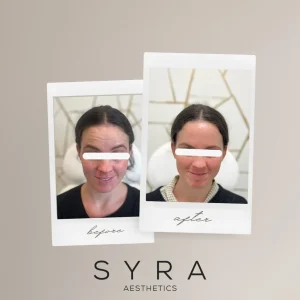
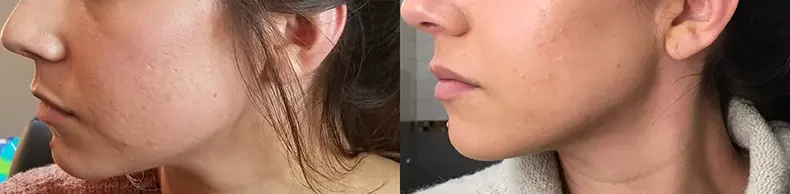
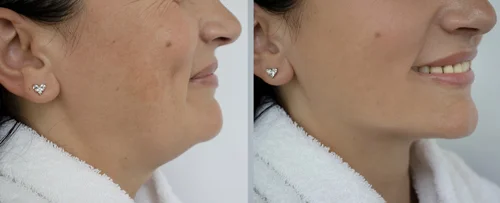
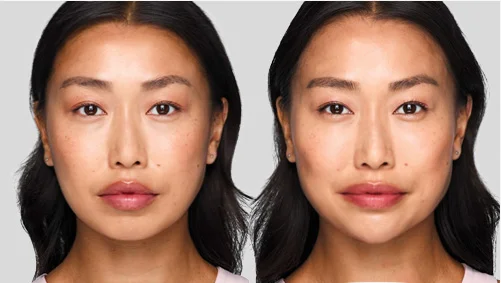
Botox before-and-after results show reduced prominence of muscle-driven lines without added facial volume. Filler results show changes in fullness, contour, projection, or fold depth.
Botox results are best compared using matching facial expressions. For example, glabellar treatment is easier to evaluate when both photographs show maximum frowning. Filler results are best compared using consistent head position, camera distance, lighting, and expression because cheek, lip, chin, and jawline treatments primarily alter three-dimensional contour.
Dermal Fillers Before And After Photos
How Soon Do Botox and Fillers Work?
Botox begins altering targeted neuromuscular activity approximately 1–2 days after injection, with visible changes developing during the first week. Most gel-based fillers create immediate or near-immediate volume, while poly-L-lactic acid fillers such as Sculptra develop more gradually.
Hyaluronic acid and calcium hydroxylapatite fillers create immediate structural volume because material occupies tissue at injection, although early swelling may temporarily affect appearance. The American Academy of Dermatology lists visible PLLA results at approximately 2–3 weeks. Sculptra labeling also explains that early fullness partly reflects reconstitution fluid and swelling that later subsides.
Which Lasts Longer Botox vs Fillers?
Most dermal fillers last longer than BOTOX Cosmetic. Botox commonly lasts about 3–4 months for cosmetic treatment, while filler longevity ranges from several months to 2 years or longer depending on the material and product.
Botox results fade as neuromuscular signaling gradually recovers and the treated muscles regain contraction. The rate of that functional recovery, together with dose, muscle strength, treatment area, and previous response, influences Botox duration.
Dermal fillers lose correction through a different process. Their longevity depends on the filler material, formulation, anatomical location, tissue movement, and how the injected material is gradually degraded or remodeled. These factors determine how long dermal fillers last, with some products maintaining correction longer in areas that experience less movement and others requiring earlier maintenance because of frequent facial motion or faster product breakdown.
Individual filler products can persist longer than these broad material estimates. For example, 67.1% of evaluated subjects treated with Juvéderm Voluma XC remained responders at 24 months in its cheek augmentation study. Filler longevity therefore cannot be reduced to one universal number. Botox has a shorter and more predictable treatment cycle, while filler duration varies more widely according to material, formulation, anatomical location, and product-specific clinical data.
How Many Units of Botox vs Fillers Are Required?
Botox and dermal fillers cannot be compared by the same dose measurement. Botox is measured in product-specific units, while dermal filler quantity is measured in milliliters or syringe volume.
For Botox, the muscles being treated, their size and contraction strength, the treatment area, and the intended degree of muscle reduction determine the required Botox dosage. FDA-labeled BOTOX Cosmetic doses include 20 Units for glabellar lines, 24 Units for lateral canthal lines, and 40 Units for forehead lines treated with the glabella.
Dermal filler quantity is determined by a different anatomical problem. Existing volume loss, deficient projection, treatment area, filler characteristics, injection plane, and the degree of structural correction determine how much filler is placed.
Botox units therefore quantify botulinum toxin potency used to modify muscle activity, while filler volume quantifies the amount of material used to modify soft-tissue volume or contour.
What Are the Risks and Side Effects of Botox vs Fillers?
Botox and dermal fillers have different risk profiles. Botox side effects primarily involve injection-site reactions and unwanted muscle weakness, while filler side effects include swelling, bruising, and tissue reactions. Fillers also carry a rare but serious risk of accidental injection into a blood vessel.
Botox Risks and Side Effects
BOTOX Cosmetic side effects depend on the treatment area, dose, injection location, and surrounding muscles. FDA clinical trials report different adverse-event rates for glabellar lines, forehead lines, and lateral canthal lines.
| Botox risk or side effect | FDA-reported frequency or clinical detail |
| Headache | Reported in 9% of BOTOX Cosmetic-treated patients in forehead-line studies, compared with 5% receiving placebo. |
| Eyelid ptosis | Reported in 2% of patients treated for forehead lines with glabellar lines and 3% of patients in glabellar-line studies. |
| Brow ptosis | Reported in 2% of patients in forehead-line studies. |
| Eyelid swelling | Eyelid edema occurred in 1% of patients treated for lateral canthal lines. |
| Facial pain | Reported in 1% of patients in glabellar-line studies. |
| Muscular weakness | Reported in 1% of patients in glabellar-line studies. Weakness can also occur in nearby muscles if the toxin affects surrounding tissue. |
| Injection-site reactions | Localized pain, tenderness, swelling, redness, inflammation, bleeding, and bruising can occur after injection. |
| Distant spread of toxin effect | BOTOX Cosmetic carries a boxed warning for toxin effects spreading beyond the injection area. Reported symptoms include generalized muscle weakness, double vision, eyelid drooping, difficulty swallowing, speech changes, and breathing difficulty. |
| Swallowing or breathing difficulty | These reactions can become life-threatening and require immediate medical attention. The FDA label states that symptoms can develop from hours to weeks after injection. |
The boxed warning requires context. FDA labeling states that no definitive serious adverse-event reports of distant toxin spread have been associated with dermatologic BOTOX/BOTOX Cosmetic use at the labeled doses of 20 Units for glabellar lines, 24 Units for lateral canthal lines, 40 Units for forehead plus glabellar lines, 44 Units for glabellar plus lateral canthal lines, or 64 Units when all 3 areas are treated together.
Dermal Filler Risks and Side Effects
Dermal filler risks differ by filler material, anatomical location, injection depth, product, and technique. The FDA separates filler complications into common, less common, and rare events rather than assigning one percentage to all dermal fillers.
| Filler risk or side effect | FDA classification or clinical detail |
| Bruising | Listed by the FDA as a common risk of dermal fillers. |
| Redness and swelling | Listed as common risks following filler injection. |
| Pain and tenderness | Listed as common risks at or around the injection site. |
| Itching or rash | Listed among the FDA’s common filler reactions. |
| Nodules or granulomas | Classified among less common risks. Raised bumps can require medication, injections, or surgical treatment. |
| Infection | Classified as a less common filler complication. |
| Delayed inflammation | Swelling or redness can develop near a previously treated area after illnesses, infections, vaccinations, or dental procedures. |
| Filler migration | Reported by the FDA as a rare complication, in which filler material moves from the original injection site. |
| Accidental intravascular injection | Filler entering a blood vessel can obstruct blood supply. Although the FDA describes the chance as low, resulting injuries can be serious and permanent. |
| Skin necrosis | Loss of blood supply after accidental vascular injection can cause tissue death. |
| Vision impairment or blindness | Accidental filler injection into a blood vessel has been associated with visual abnormalities, including blindness. |
| Stroke | Vascular filler complications have also been associated with cerebral ischemia, cerebral hemorrhage, and stroke. |
Sudden vision changes, unusual severe pain, white, gray, or blue skin near the filler injection site, difficulty speaking, facial weakness, or other stroke symptoms require immediate medical attention. The FDA identifies these findings as warning signs of possible accidental intravascular filler injection.
Which Is Safer Botox Vs Filler?
Neither treatment is categorically safer in every patient or anatomical area. Botox carries pharmacologic risks related to neuromuscular weakening and toxin spread, while fillers carry anatomical and vascular risks associated with material placement.
Botox safety depends on authentic product sourcing, correct dose, injection location, medical history, and neuromuscular anatomy. The source states that in November 2025, the FDA warned companies marketing unapproved or misbranded botulinum toxin products after reports involving unapproved products and botulism symptoms.
Filler safety depends heavily on product selection, vascular anatomy, injection depth, technique, and complication management. The FDA advises patients to use licensed healthcare providers familiar with filler anatomy, injection technique, and complication management.
Can Botox or Fillers Be Reversed?
Botox has no injectable antidote that immediately reverses its cosmetic effect. Hyaluronic acid fillers can be enzymatically degraded with hyaluronidase, although aesthetic filler dissolution is an off-label clinical use. Non-HA fillers such as Sculptra, Radiesse, and Bellafill do not dissolve with hyaluronidase.
Botox effects decline as neuromuscular signaling recovers. Hyaluronidase breaks down hyaluronic acid and is used clinically to reduce or remove HA-based fillers. Research has demonstrated degradation of products including Juvéderm, Restylane, and Belotero after hyaluronidase exposure. Calcium hydroxylapatite, poly-L-lactic acid, and PMMA do not respond to hyaluronidase because they are not hyaluronic acid. Reversibility depends on the specific filler material, not the filler category as a whole.
What Is the Downtime?
Botox has no required recovery period, and normal activities can resume immediately. Fillers also allow most patients to return to daily activities quickly, although swelling, redness, tenderness, or bruising can remain visible longer.
The American Society of Plastic Surgeons states that botulinum toxin injections require no downtime or recovery time. Rubbing or massaging the treated Botox area is discouraged because toxin movement can affect neighboring muscles.
Filler recovery varies by material, site, injected volume, and individual response. The AAD reports that common minor reactions often resolve within 7–14 days or earlier. ASPS recommends avoiding intense physical activity for approximately 24–48 hours to limit swelling and bruising. Downtime and time until the final appearance are different. A patient may return to work while swelling or bruising remains visible.
How Much Do Botox and Fillers Cost?
In New York City, Botox commonly costs about $12–$25+ per unit, while dermal fillers often cost approximately $700–$1,400 per syringe. The treatments are priced differently because Botox quantity is measured in units and filler quantity is measured by injected volume.
For Botox, the treatment area and muscle activity determine how many units are required, and that unit requirement directly influences Botox cost when treatment is priced per unit. Treating several muscles or using a larger total dose therefore changes the total price.
For dermal fillers, the anatomical volume deficit and degree of correction determine how many syringes or vials are required. Filler material, product selection, anatomical complexity, and injector expertise also influence the final treatment price.
Botox NYC Pricing
Botox NYC pricing varies primarily by the number of units injected. Published 2026 NYC pricing data place Botox at approximately $12–$25+ per unit, with dermatology and premium Manhattan practices often charging toward the upper end of the range.
| Botox Pricing in NYC | NYC Cost |
| Botox per unit | $12–$25+ |
| Forehead treatment | About $200–$500 |
| Crow’s feet | About $150–$430 |
| Frown lines / 11 lines | About $240–$540 |
Published NYC practices also show current Botox prices around $15–$16 per unit, illustrating how individual provider pricing differs across Manhattan.
Dermal Filler Pricing in NYC
Dermal fillers are priced per syringe rather than per unit. Current Manhattan pricing for hyaluronic acid fillers falls around $700–$1,400 per syringe, although specific products and premium practices can exceed this range.
| Filler Pricing in NYC | NYC Cost |
| Hyaluronic acid filler | About $700–$1,400 per syringe |
| Lip filler | About $650–$1,200 per syringe |
| Juvéderm products | About $700–$1,200+ per syringe |
| Radiesse | About $600+ per syringe |
| Sculptra | About $650–$750+ per vial |
For example, one current NYC practice lists Juvéderm fillers from $700 to $1,200 per syringe, Radiesse at $600 per syringe, and Sculptra at $750 per vial. Another Manhattan practice lists Botox at $15 per unit and filler at $700 per syringe.
The final treatment cost depends on how much Botox or filler is required. Botox cost increases with the number of units, while filler cost increases with the number of syringes or vials. Product choice, anatomical complexity, treatment goals, and injector expertise also affect the final NYC price.
Can Botox and Fillers Be Used Together?
Yes. Botox and fillers can be used in the same facial treatment plan because they change different anatomical components. Botox reduces selected muscle activity, while fillers restore or add tissue volume.
For example, upper-face Botox may be combined with cheek, chin, lip, or lower-face filler. Botox addresses movement; filler addresses structure. Combination treatment does not mean every wrinkle requires both products. One anatomical cause requires a matching mechanism; multiple causes may require multiple mechanisms.
When Are Neither Botox Nor Fillers the Right Treatment?
Neither Botox nor filler matches every sign of facial aging. Botox does not replace structural volume, and fillers do not reposition substantially sagging tissue or directly correct pigmentation and surface damage.
Significant skin and soft-tissue laxity may require structural repositioning. Fillers add volume but do not reproduce the tissue repositioning achieved by a facelift, brow lift, or eyelid surgery.
Pigmentation, rough texture, photodamage, and some superficial lines primarily involve skin quality rather than muscle contraction or missing volume. Resurfacing treatments target these concerns through different mechanisms.
Medical contraindications can also exclude injectable treatment. BOTOX Cosmetic is contraindicated in people with known hypersensitivity to botulinum toxin preparations or infection at the proposed injection site. Filler treatment requires screening for allergies, bleeding disorders, active inflammation, infection, previous filler materials, and product-specific contraindications.
How Does Sculptra Compare With Botox and Hyaluronic Acid Fillers?
Sculptra is a poly-L-lactic acid dermal filler with a gradual biostimulatory treatment pattern. Botox reduces muscle contraction, conventional HA fillers create immediate gel-based volume, and Sculptra produces progressive correction over weeks.
| Attribute | Botox | Hyaluronic Acid Filler | Sculptra |
| Class | Botulinum toxin drug | Dermal filler | PLLA dermal filler |
| Primary mechanism | Reduces neuromuscular signaling | Adds gel-based volume | Produces gradual structural tissue response |
| Visible onset | Days | Immediate/near immediate | Weeks |
| Measurement | Units | mL | Vials/injected volume |
| Broad duration | About 3–4 months for glabellar lines | Product/site dependent | Up to 2 years |
| Hyaluronidase dissolution | No | Yes | No |
| Main target | Muscle activity | Volume and contour | Progressive facial correction |
FDA materials describe PLLA as a biodegradable synthetic polymer whose results become increasingly apparent over several weeks and can last up to 2 years.
Sculptra often uses a treatment series. FDA labeling for certain facial indications describes 1–4 treatment sessions, 3, with at least 3 weeks between sessions, although the regimen depends on the approved use and required correction.
Sculptra is a specific non-HA filler subtype, not an unrelated third injectable category.
What Are the Pros and Cons of Botox vs Fillers?
Botox and dermal fillers provide different benefits because they change different anatomical components. Botox benefits concerns created by excessive or repeated muscle contraction, while fillers benefit concerns caused by lost volume, inadequate projection, or structural contour deficits.
By reducing contraction in selected muscles, Botox decreases the repetitive movement that produces dynamic facial lines. This relationship between reduced muscle activity and softer movement-related lines explains the primary benefits of Botox.
Dermal fillers provide a different benefit by placing material within soft tissue. Added volume can restore cheek fullness, increase lip volume, improve chin projection, soften selected folds, or change facial contour.
Neither mechanism replaces the other: reducing muscle activity does not restore missing volume, and adding volume does not directly reduce neuromuscular contraction.
Botox Pros and Cons
| Botox Pros | Botox Cons |
| Targets dynamic wrinkles caused by repeated muscle contraction, including frown lines, forehead lines, and crow’s feet. | Does not restore lost facial volume in areas such as the cheeks, lips, or chin. |
| Botox benefits patients with muscle-driven wrinkles by reducing targeted muscle contraction without adding facial volume. | Produces temporary results, with labeled glabellar-line effects lasting approximately 3–4 months. |
| Requires minimal recovery, with no required downtime for most cosmetic treatments. | Requires repeat treatments to maintain reduced muscle activity. |
| Produces targeted muscle relaxation, allowing specific muscles to be treated according to facial anatomy. | Can cause temporary side effects, including bruising, headache, eyelid ptosis, brow ptosis, and unwanted muscle weakness. |
| Uses product-specific units, allowing dosing to be planned according to the treatment area and muscle activity. | Has no immediate reversal agent that removes the cosmetic effect after injection. |
| Does not permanently alter muscle function, because neuromuscular activity gradually returns as the treatment wears off. | Carries a boxed warning for distant spread of toxin effect, which can cause serious neuromuscular symptoms in rare circumstances. |
Dermal Filler Pros and Cons
| Dermal Filler Pros | Dermal Filler Cons |
| Restores or adds facial volume in areas affected by volume loss or inadequate projection. | Does not reduce muscle contraction, so it does not directly treat dynamic wrinkles caused by facial movement. |
| Improves facial contour, including the cheeks, lips, chin, jawline, and selected facial folds. | Can cause temporary reactions, including swelling, bruising, redness, tenderness, itching, and pain. |
| Produces immediate or near-immediate volume with many hyaluronic acid fillers. | Can produce delayed complications, including nodules, granulomas, infection, inflammation, and filler migration. |
| Lasts longer than Botox in many cases, with duration ranging from months to years depending on the filler material and product. | Carries a rare but serious vascular risk if filler is accidentally injected into a blood vessel. |
| Hyaluronic acid fillers can be degraded with hyaluronidase, providing a method of reducing or removing HA filler when clinically appropriate. | Vascular occlusion can cause tissue necrosis, vision loss, or stroke in severe cases. |
| Offers multiple filler materials, including hyaluronic acid, calcium hydroxylapatite, poly-L-lactic acid, and PMMA. | Not all fillers are reversible because hyaluronidase only degrades hyaluronic acid fillers. |
The main difference remains anatomical. Botox benefits muscle-driven concerns, while dermal fillers benefit volume-related and structural concerns. Neither treatment replaces the mechanism or function of the other.
Which Should You Choose: Botox or Fillers?
Choose Botox when muscle contraction primarily causes the concern. Choose filler when lost volume, inadequate projection, or structural contour primarily causes it. Consider a combined plan when both mechanisms are present. Choose neither when another anatomical layer or process is responsible.
| Primary concern | Treatment relationship |
| Glabellar movement lines | Botox |
| Crow’s feet caused by muscle contraction | Botox |
| Forehead movement lines | Botox |
| Platysma bands | Botox |
| Reduced cheek volume | Filler |
| Lip volume or shape | Filler |
| Chin projection deficit | Filler |
| Jawline volume/definition | Filler |
| Selected folds caused by volume changes | Filler |
| Dynamic wrinkles + facial volume loss | Botox + filler |
| Significant tissue laxity | Neither injectable replaces surgical repositioning |
| Pigmentation or surface photodamage | Neither directly targets the primary cause |
The deciding question is not whether Botox or filler is better. It is which anatomical mechanism creates the visible concern. Botox changes muscle activity. Fillers change tissue volume or structure.
Frequently Asked Questions
Does Botox or Filler Hurt More?
Both Botox and dermal fillers can cause brief injection-site discomfort, but the source and sensation differ because the procedures place different substances into different tissues.
Botox discomfort primarily comes from needle penetration as small amounts of product are injected at selected muscle treatment points. Needle size, number of injection sites, treatment location, and individual sensitivity influence how much Botox injections hurt.
Dermal filler treatment can involve both needle or cannula entry and pressure as filler material is deposited within a selected tissue plane. The product volume, treatment area, injection depth, tissue sensitivity, and use of anesthetic therefore influence filler discomfort.
Pain from either treatment is procedural rather than the mechanism responsible for its cosmetic effect: Botox works through neuromuscular inhibition, while fillers work through soft-tissue augmentation.
What Happens If You Stop Getting Botox or Fillers?
Stopping treatment allows temporary effects to decline without causing withdrawal. Botox-treated muscles gradually regain activity as neuromuscular signaling recovers. Absorbable fillers progressively lose correction as material is metabolized or tissue effects decline. Facial aging continues.
Does Age Determine Whether Botox or Filler Is Better?
Age alone does not determine treatment selection; anatomy does. People of the same age can differ in muscle activity, facial volume, bone structure, skin quality, and tissue laxity.
FDA approval still establishes age-related regulatory boundaries. FDA-approved filler indications begin at age 22, while BOTOX Cosmetic is indicated for adults.
Are Botox Units the Same as Dysport, Xeomin, or Other Toxin Units?
No. BOTOX Cosmetic units are product-specific and cannot be directly converted into units of other botulinum toxin products.
A treatment described as “20 units” has meaning only when the botulinum toxin product is identified.
Can Previous Fillers Affect Future Injectable Treatments?
Yes. Previous filler material, location, quantity, and treatment date matter when planning future injections.
Hyaluronic acid, calcium hydroxylapatite, PLLA, and PMMA differ in persistence and reversibility. Permanent or long-lasting materials require particular attention because they may remain after the visible cosmetic effect changes.
Can Dermal Fillers Appear on Medical Imaging?
Some filler materials can affect medical imaging. The FDA states that calcium hydroxylapatite filler remains visible on X-rays and can obscure underlying features.
Patients with previous filler treatment should tell medical professionals which filler material was used and where it was injected.

Written & Medically Reviewed by
Dr. Syra Hanif, M.D.
Board-Certified Primary Care Physician
Dr. Syra Hanif, M.D., is a board-certified physician specializing in aesthetic medicine, longevity, and preventative wellness. As Medical Director of Dr. Syra Aesthetics & Longevity Institute in NYC, she focuses on aesthetics, healthy aging, and overall wellness.
Read More