


There is no single number of Botox units that everyone needs. The appropriate dose for a Botox treatment in NYC depends on the treatment area, muscle size and activity, facial anatomy, movement pattern, and treatment goal. For FDA-approved cosmetic uses, BOTOX Cosmetic has labeled reference doses, including 20 units for frown lines, 24 units for crow’s feet, and 40 units for forehead lines treated together with frown lines. Treating the forehead, frown lines, and crow’s feet together uses 64 units under the labeled dosing regimen. Other areas, such as the masseters and lips, use individualized dosing based on the specific muscles being treated.
Key Points
- Botox units vary by treatment area. A total dose only makes sense when you know which muscles and areas are being treated.
- 20 units is the FDA-labeled dose for frown lines, while crow’s feet use 24 units total.
- Forehead lines and frown lines use 40 units total under the FDA-labeled treatment regimen.
- Muscle size, strength, facial anatomy, movement, and treatment goals influence how many Botox units are appropriate.
- Botox treatment in NYC should be individualized according to the muscles being treated and the degree of movement reduction needed.
- A Botox unit is not the same as an injection or injection site. Several units can be delivered at one injection point.
How Many Units of Botox Is Normally Recommended?
The number of Botox units people receive varies according to which areas are treated. A total such as 20, 40, or 60 units does not tell you whether the dose is high or low unless you also know where those units are being injected.
For example:
- 20 units is the FDA-labeled BOTOX Cosmetic dose for glabellar or frown lines.
- 24 units is the labeled total for crow’s feet, with 12 units on each side.
- 40 units is the labeled total for treating forehead lines together with frown lines.
- 44 units treats frown lines and crow’s feet together according to the labeled dosing regimen.
- 64 units treats the forehead, frown lines, and crow’s feet together.
What Is a Botox Unit?
A Botox unit is a measure of the biological activity or potency of BOTOX Cosmetic, not a measurement of liquid volume.
A Botox unit is therefore not the same as:
- one injection;
- one injection site;
- one syringe;
- one milliliter of liquid;
- one treatment area.
Several units can be placed at one injection site, and several injection sites can be used within the same treatment area.
For example, the FDA-labeled treatment for frown lines uses 20 total units distributed across five injection sites. Crow’s feet treatment uses 24 units across six injection points, with three sites on each side. Understanding this distinction makes Botox dosage easier to interpret. When an injector recommends 40 units, the important question is not simply “Is 40 a lot?” but where those 40 units are being placed and which muscles are being treated.
FDA-Approved Botox Units by Treatment Area
BOTOX Cosmetic has specific FDA-labeled doses for its approved cosmetic treatment areas.
| Treatment Area | Muscle Involved | FDA-Labeled BOTOX Cosmetic Dose |
|---|---|---|
| Frown lines / glabellar lines | Corrugator and procerus | 20 units |
| Crow’s feet / lateral canthal lines | Orbicularis oculi | 24 units total, 12 per side |
| Forehead + frown lines | Frontalis + glabellar muscles | 40 units total |
| Frown lines + crow’s feet | Glabellar muscles + orbicularis oculi | 44 units total |
| Forehead + frown lines + crow’s feet | Frontalis + glabellar muscles + orbicularis oculi | 64 units total |
| Platysma bands | Platysma | 26, 31, or 36 units depending on band presentation |
The current prescribing information identifies 20 units for glabellar lines, 24 units for lateral canthal lines, 40 units for forehead and glabellar lines together, and 26, 31, or 36 units for platysma bands depending on the number and distribution of bands.
How Many Units of Botox for Frown Lines?
The FDA-labeled dose for moderate to severe frown lines between the eyebrows is 20 units. These vertical “11” lines are associated mainly with activity in the corrugator and procerus muscles. The labeled treatment distributes the 20 units across five injection sites in these muscles. Muscle anatomy matters because the goal is not simply to inject a predetermined number of units. The injector also needs to identify the muscles responsible for the movement producing the lines.
How Many Units of Botox for the Forehead?
For moderate to severe forehead lines, the FDA-labeled treatment uses 20 units in the frontalis together with 20 units in the glabellar region, for 40 units total. The frontalis muscle raises the eyebrows, so forehead treatment requires attention to both dose and placement. The prescribing information specifically directs clinicians to consider forehead size and the distribution of frontalis muscle activity when selecting injection locations.
How Many Units of Botox for Crow’s Feet?
The FDA-labeled dose for moderate to severe crow’s feet is 24 units total, with 12 units on each side. The crows feet treatment targets the lateral orbicularis oculi, the muscle surrounding the eye that contributes to the lines that appear when smiling or squinting. The labeled regimen distributes the dose across three injection sites on each side. When crow’s feet and frown lines are treated during the same session, the labeled total is 44 units.
How Many Units of Botox for Forehead, Frown Lines and Crow’s Feet?
Treating all three FDA-approved upper-face areas uses 64 units total:
- Forehead lines: 20 units
- Frown lines: 20 units
- Crow’s feet: 24 units
The important point is that 64 units is not automatically “a lot of Botox.” It represents the established treatment dose for three separate upper-face regions.
Botox Units for Other Aesthetic Treatment Areas
Botox is also used aesthetically in areas such as the masseters, lips, nose, chin, and brows. These applications should not be placed in the same category as FDA-labeled cosmetic doses because dosing is more individualized and some uses are off-label.
Masseter Botox
The masseter is a large jaw muscle, so masseter Botox units are higher than the amounts used for smaller facial muscles. The appropriate dose depends on masseter thickness, muscle strength, facial width, symmetry between both sides, and the treatment goal. Recent clinical trials evaluating onabotulinumtoxinA for masseter muscle prominence have studied total bilateral doses of 48 and 72 units, showing why masseter treatment cannot be directly compared with smaller upper-face areas. The final number of masseter Botox units should still be determined through an individualized anatomical assessment.
Lip Flip
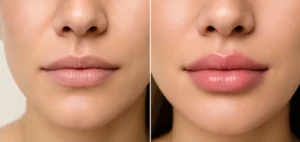
A Botox lip flip uses small amounts of botulinum toxin around the orbicularis oris muscle to reduce inward pull of the upper lip. Published techniques commonly use around 4 to 6 Botox lip flip units, although the exact amount varies based on facial anatomy, muscle activity, technique, and treatment goals. Because the orbicularis oris is a small, functionally important muscle involved in lip movement, precise placement and conservative treatment planning are important.
Bunny Lines, Chin and Eyebrow Lift
Botox can also be used for aesthetic concerns involving areas such as:
- bunny lines around the nose;
- chin dimpling;
- selected muscles involved in brow position.
These treatments use different muscles and treatment goals, so there is no single unit range that should be applied to every patient or every lower-face treatment. The dose should follow the muscle being treated rather than the name of a broad facial region.
What Affects How Many Units of Botox You Need?
The number of Botox units is determined by more than wrinkle depth. The treatment plan considers the relationship between the muscle, facial anatomy, movement pattern, treatment area, and desired result.
Muscle Strength and Size
Larger or more active muscles can require a different dose than smaller muscles.
This is particularly relevant when comparing a large muscle such as the masseter with much smaller muscles around the lips or nose.
Treatment Area
Different areas contain different muscles with different functions.
For example:
- Frontalis raises the eyebrows.
- Corrugator and procerus contribute to frown lines.
- Orbicularis oculi contributes to crow’s feet.
- Masseter closes the jaw and contributes to lower-face width.
- Platysma affects the neck and lower-face contour.
The number of units therefore follows the specific muscle and treatment objective, not simply the size of the facial area.
Facial Anatomy
Forehead height, brow position, facial proportions, muscle distribution, and natural asymmetry all affect treatment planning.
Two patients with similar-looking forehead lines can have different movement patterns, which can change where Botox is placed.
Facial Movement
Botox temporarily reduces activity in targeted muscles. An injector therefore evaluates the face at rest and during movement.
For example, forehead lines become more visible when the frontalis contracts, while crow’s feet become more prominent during smiling or squinting.
Desired Amount of Movement
The amount of facial movement a patient wants to maintain influences the Botox treatment plan. Some patients prefer softer muscle activity with more natural expression, while others want greater relaxation in the treated area.
The injector adjusts the dose, injection placement, and muscles treated to achieve the desired level of movement while maintaining balanced facial expression.
Previous Treatment Response
How a patient responded to previous Botox treatment can provide useful information for planning later sessions.
Duration, degree of muscle relaxation, symmetry, and remaining movement can all be assessed before determining the next treatment plan.
How Many Units of Botox Do You Need for Your First Treatment?
There is no universal first-time Botox dose.
A first treatment still depends on:
- the area being treated;
- muscle strength;
- facial movement;
- anatomy;
- treatment goals;
- the amount of movement the patient wants to maintain.
For example, someone treating only frown lines has a completely different unit requirement from someone treating the forehead, frown lines, and crow’s feet together.
The most useful approach for a first treatment is to establish which muscles are responsible for the concern and what degree of muscle relaxation is appropriate, rather than selecting an arbitrary low number simply because it is the patient’s first appointment.
Is 20, 40, 50 or 60 Units of Botox a Lot?
A Botox unit total is not high or low without knowing the treatment area. Twenty units is the FDA-labeled dose for frown lines, while 40 units treats the forehead and frown lines together. Higher totals can represent multiple areas or treatment of larger muscles.
| Total | Context |
|---|---|
| 20 | FDA-labeled frown-line dose |
| 40 | FDA-labeled forehead + glabellar treatment |
| 44 | Frown lines + crow’s feet |
| 64 | Forehead + frown lines + crow’s feet |
| 50–60 | Interpretation depends on treatment areas/muscles |
Do Men and Women Need Different Botox Units?
Not necessarily. Botox dosing is determined primarily by the treated muscle, muscle size and strength, facial anatomy, movement pattern, and treatment objective. Men can have larger or stronger facial muscles in some regions, particularly the glabella, which can affect dose requirements. Clinical dose-ranging research in men with moderate to severe glabellar lines found stronger responses and longer duration with studied doses of 40, 60, and 80 units compared with 20 units. However, those findings do not establish a universal male Botox dose. Individual anatomy remains more useful than gender alone when planning treatment.
Does More Botox Last Longer?
More Botox does not automatically produce better or longer-lasting results. Higher doses can extend treatment response in some studied situations, but duration also depends on the treatment area, muscle activity, formulation, and individual response.
The appropriate dose is the amount needed to achieve the treatment objective while preserving the desired level of muscle function. Increasing the number of units beyond that requirement does not automatically improve the result.
What Happens If Too Little Botox Is Used?
Too little Botox can leave more muscle activity than intended, resulting in less wrinkle reduction or movement control. Whether additional units are appropriate depends on the treated muscle, anatomy, initial dose, and treatment goal rather than the remaining movement alone.
What Happens If Too Much Botox Is Used?
Too much Botox or inappropriate placement can weaken muscles beyond the intended treatment effect. Depending on the area treated, this can contribute to unwanted effects such as brow or eyelid drooping, excessive weakness, or changes in nearby facial movement.
This is why Botox dosing is based on the specific muscle, facial anatomy, and amount of movement that needs to be reduced rather than simply using more units.
Does the Number of Botox Injection Sites Equal the Number of Units?
No. Botox units and injection sites are different.
For example:
- Frown lines use 20 total units across five labeled injection sites.
- Crow’s feet use 24 total units across six injection sites.
- Forehead treatment uses 20 units across five forehead injection sites, together with the glabellar treatment when following the labeled regimen.
So receiving 20 units does not mean receiving 20 injections.
Are Botox and Dysport Units the Same?
No. Botox and Dysport units are product-specific and cannot be directly converted or compared one-to-one. For glabellar lines, the FDA-labeled dose is 20 units of BOTOX Cosmetic versus 50 units of Dysport, even though both target the same general treatment area.
Because each product uses its own potency measurement and dosing system, comparing unit numbers alone does not establish an equivalent dose. This product-specific dosing difference is central to how Botox and Dysport differ when the same cosmetic concern is being treated.
How Do Botox Units Affect Cost?
Botox units affect total treatment cost because many practices charge according to the amount of product administered. When a treatment requires more units because several areas or larger muscles are being treated, the higher total dose becomes one of the main factors that increases Botox cost in NYC.
Treatment area, muscle size, provider pricing, practice location, and the individual treatment plan can also affect the final amount. A unit chart therefore cannot determine the total price without first establishing which muscles and treatment areas require Botox.
How Do You Know Whether Your Botox Unit Recommendation Makes Sense?
If an injector recommends 20, 40, 50, 60, or another number of units, the total alone does not tell you whether the recommendation is appropriate.
Ask these questions:
- Which areas are being treated?
- Which muscles are being targeted?
- How many units are going into each area?
- Is the quoted number the total dose or the dose per side?
- Is the treatment FDA-approved for that indication or an individualized/off-label aesthetic use?
- How much facial movement is the treatment intended to preserve?
- Which botulinum toxin product is being used?
A clear treatment plan should connect the number of units to the anatomy and goal rather than presenting the dose as an unexplained package.
How Are Botox Units Determined at Dr. Syra Aesthetics?
Dr. Syra Hanif determines Botox units according to the treatment area, target muscle, muscle strength, facial movement, symmetry, and the amount of expression the patient wants to preserve. The same total number of units can represent very different treatments depending on which muscles receive them and how the dose is distributed. This individualized dose selection is part of planning Botox treatment in NYC because the treatment plan connects the patient’s facial anatomy and movement pattern to the number of units placed in each area.
Frequently Asked Questions
Can I Ask for Fewer Units of Botox?
Yes, you can discuss the amount of movement and degree of correction you want during your consultation. The final treatment plan should still be based on the muscle being treated, anatomy, and appropriate dosing rather than choosing an arbitrary unit number.
Can Two People Get the Same Botox Units and Have Different Results?
Yes. Muscle strength, facial anatomy, movement patterns, injection placement, and individual response can differ even when the same total number of units is used.
Do Deeper Wrinkles Always Need More Botox Units?
No. Wrinkle depth alone does not determine the dose. Botox acts on muscle activity, so the treated muscle, movement pattern, anatomy, and treatment objective also matter.
Is There a Standard Number of Units for Full-Face Botox?
No. “Full-face Botox” does not have one universal unit total because the term can include very different combinations of treatment areas. A plan treating the forehead, frown lines, and crow’s feet is different from one that also includes the masseters, lips, chin, nose, or neck.
**Disclaimer **
This blog is for informational & educational purposes only and does not intend to substitute any professional medical advice or consultation. For any health-related concerns, please consult with your physician, or call 911.

Written & Medically Reviewed by
Dr. Syra Hanif, M.D.
Board-Certified Primary Care Physician
Dr. Syra Hanif, M.D., is a board-certified physician specializing in aesthetic medicine, longevity, and preventative wellness. As Medical Director of Dr. Syra Aesthetics & Longevity Institute in NYC, she focuses on aesthetics, healthy aging, and overall wellness.
Read More