



What Are Peptides and How Do Weight-Loss Peptides Work?
Peptides are short chains of amino acids that act as biological messengers in the body. Some influence appetite, metabolism, and fat storage, making them a focus in obesity treatment.
The most important group for weight loss is GLP-1 receptor agonists such as semaglutide and liraglutide. These peptides mimic the natural gut hormone glucagon-like peptide-1 (GLP-1), which:
Slows gastric emptying, keeping food in the stomach longer.
Enhances satiety signals in the brain, helping people feel full sooner and for longer.
Regulates blood sugar by triggering insulin release after meals.
This mechanism has been validated in clinical trials. For example, in the STEP 1 trial, patients taking semaglutide lost an average of 14.9% of their body weight over 68 weeks, compared with just 2.4% in the placebo group (NEJM study).
Other peptides like CJC-1295 or AOD-9604 are marketed for fat loss, but unlike GLP-1 drugs, they lack robust human data and are not FDA-approved for obesity (FDA warning on unapproved peptides).
Do Peptides Really Work for Weight Loss?
Yes, but only certain peptides with clinical approval have been proven effective. Others are either experimental or marketed without sufficient evidence.
Which Peptides Are Proven to Work Best for Weight Loss?
When it comes to peptides used for weight loss, the strongest evidence supports FDA-approved prescription medications that act on GLP-1 or GIP/GLP-1 pathways. These medications influence appetite, fullness, digestion, and blood sugar regulation, helping eligible patients reduce calorie intake and achieve clinically meaningful weight loss when combined with appropriate lifestyle changes.
The three main active ingredients used in this category are semaglutide, liraglutide, and tirzepatide. However, not every brand containing these ingredients is specifically approved for weight management.
| Active Ingredient | Weight-Loss Brand | Type |
|---|---|---|
| Semaglutide | Wegovy | GLP-1 agonist |
| Liraglutide | Saxenda | GLP-1 agonist |
| Tirzepatide | Zepbound | GIP + GLP-1 agonist |
Semaglutide (Ozempic, Wegovy, Rybelsus)
Semaglutide is a GLP-1 receptor agonist that mimics a natural gut hormone involved in appetite, digestion, and blood sugar regulation. It helps reduce hunger, increases feelings of fullness, and can lower calorie intake. Although Wegovy, Ozempic, and Rybelsus all contain semaglutide, they have different FDA-approved uses, dosing approaches, and expected weight-loss outcomes.
Wegovy is specifically FDA-approved for long-term weight management in eligible adults with obesity or overweight and a weight-related health condition. A healthcare provider may prescribe it when weight loss is the primary treatment goal and lifestyle changes alone have not produced sufficient results.
In the STEP 1 trial, adults receiving once-weekly semaglutide 2.4 mg lost an average of about 14.9% of their starting body weight over 68 weeks. Benefits may also include improvements in waist circumference and other cardiometabolic risk factors.
Common side effects include nausea, diarrhea, vomiting, constipation, abdominal discomfort, headache, and fatigue.
Ozempic also contains semaglutide but is primarily FDA-approved for adults with type 2 diabetes. Healthcare providers may prescribe it when improved blood sugar control is needed, particularly in patients who may also benefit from its cardiovascular or kidney-related indications.
Weight loss can occur during treatment, but Ozempic itself is not FDA-approved specifically for weight loss. In one diabetes trial, participants lost approximately 5.6 kg with the 1 mg dose and 6.4 kg with the 2 mg dose over 40 weeks. These results should not be directly compared with Wegovy’s obesity trials because the doses, populations, and study designs differed.
Common side effects include nausea, vomiting, diarrhea, abdominal pain, and constipation.
Rybelsus is an oral semaglutide tablet primarily prescribed for adults with type 2 diabetes. A healthcare provider may consider it when improved blood sugar control is needed and an oral GLP-1 medication is appropriate.
Rybelsus is not specifically FDA-approved for weight loss, although weight reduction may occur. In several 26-week diabetes trials, patients receiving the 14 mg formulation lost approximately 3.1 to 4.4 kg, depending on the study and other medications being used.
Common side effects include nausea, abdominal pain, diarrhea, decreased appetite, vomiting, and constipation.
Which one to take? If weight management is the primary goal and semaglutide is medically appropriate, Wegovy is the semaglutide product specifically approved for long-term weight management. Ozempic and Rybelsus are primarily prescribed for type 2 diabetes and related indications.
Liraglutide (Saxenda, Victoza)
Liraglutide is another GLP-1 receptor agonist that helps regulate appetite, digestion, and blood sugar. It slows gastric emptying and increases feelings of fullness, which can help patients reduce calorie intake. Unlike Wegovy and Zepbound, liraglutide is administered as a once-daily injection.
Saxenda is FDA-approved specifically for chronic weight management. A healthcare provider may prescribe it to adults with a BMI of 30 or higher, or a BMI of 27 or higher with at least one weight-related health condition, when medically appropriate.
In a major 56-week clinical trial, adults taking liraglutide 3 mg lost an average of approximately 8% of their starting body weight, compared with 2.6% with placebo. About 63% of participants lost at least 5% of their body weight. Additional benefits may include reductions in waist circumference and improvements in certain cardiometabolic risk factors.
Common side effects include nausea, diarrhea, constipation, vomiting, decreased appetite, indigestion, headache, fatigue, and abdominal discomfort.
Victoza contains the same active ingredient but is FDA-approved primarily for type 2 diabetes. Healthcare providers may prescribe it when additional blood sugar control is needed, and it also has cardiovascular indications for certain adults with type 2 diabetes.
Weight loss may occur during treatment, but Victoza is not specifically approved as a weight-loss medication. In one 26-week diabetes trial, patients lost approximately 2.7 kg with 1.2 mg and 3.3 kg with 1.8 mg daily.
Which one to take? When weight management is the primary goal and liraglutide is appropriate, Saxenda is the liraglutide product specifically approved for weight management. Victoza is primarily used for type 2 diabetes.
Tirzepatide (Zepbound, Mounjaro)
Tirzepatide is a dual GIP and GLP-1 receptor agonist, meaning it acts on two hormone pathways involved in appetite, blood sugar regulation, and metabolism. It reduces hunger, increases feelings of fullness, slows digestion, and can substantially reduce calorie intake.
Both Zepbound and Mounjaro contain tirzepatide and are administered as once-weekly injections, but they have different FDA-approved indications.
Zepbound is FDA-approved for long-term weight reduction and weight maintenance in adults with obesity or overweight and at least one weight-related health condition. A healthcare provider may prescribe it when a patient meets medical eligibility criteria and additional medical support for weight management is appropriate.
In the SURMOUNT-1 trial, adults without diabetes lost an average of approximately 15.0% with 5 mg, 19.5% with 10 mg, and 20.9% with 15 mg over 72 weeks. Tirzepatide also produced improvements in waist circumference, blood pressure, glucose metabolism, and lipid levels.
Zepbound is also FDA-approved to treat moderate to severe obstructive sleep apnea in adults with obesity who meet the appropriate treatment criteria.
Mounjaro contains tirzepatide but is FDA-approved primarily for type 2 diabetes. Healthcare providers may prescribe it when improved blood sugar control is needed alongside diet and exercise.
Weight reduction is frequently seen during treatment. In one 40-week diabetes trial, participants lost approximately 6.3 kg with 5 mg, 7.0 kg with 10 mg, and 7.8 kg with 15 mg. Other trials have reported different amounts depending on the dose and study population, so these figures should not be directly compared with Zepbound’s obesity studies.
Common side effects of tirzepatide include nausea, diarrhea, decreased appetite, vomiting, constipation, indigestion, and abdominal pain. Some patients taking Zepbound may also experience injection-site reactions, fatigue, dizziness, reflux, or hair loss associated with weight reduction.
More serious potential risks with GLP-1 and GIP/GLP-1 medications can include pancreatitis, gallbladder problems, dehydration-related kidney injury, severe gastrointestinal reactions, and hypoglycemia when combined with certain diabetes medications. These medications also have important contraindications and warnings that should be reviewed with a healthcare provider before treatment.
Which one to take? If weight loss is the primary treatment goal and tirzepatide is medically appropriate, Zepbound is the tirzepatide product specifically approved for weight management. Mounjaro is primarily prescribed for type 2 diabetes.
Retatrutide (Investigational — Not Yet FDA-Approved)
Retatrutide is an experimental triple hormone-receptor agonist that acts on GLP-1, GIP, and glucagon receptors — one pathway more than tirzepatide. It is being developed for obesity but is not yet FDA-approved, and is currently in Phase 3 trials.
Early results have drawn significant attention. In a Phase 2 trial, adults with obesity lost an average of up to 24.2% of body weight at 48 weeks on the highest dose — the largest reduction reported for an incretin-based drug to date ().
Because it is still investigational, retatrutide is not available as an approved prescription weight-loss medication, and long-term safety in large populations is still being studied. Side effects reported so far are similar to other incretin drugs — mainly gastrointestinal (nausea, diarrhea). Any product sold online as “retatrutide” outside a clinical trial is unregulated and carries the same risks as other unapproved research chemicals.
Wegovy vs Zepbound vs Saxenda: Which Is Better for Weight Loss?
| Treatment | Dosing | Best Known For |
|---|---|---|
| Zepbound | Weekly | Greatest average weight loss in its obesity trial |
| Wegovy | Weekly | Strong, established GLP-1 weight-loss evidence |
| Saxenda | Daily | Established liraglutide option for weight management |
Weight-loss results in separate obesity trials: Zepbound about 20.9% over 72 weeks, Wegovy about 14.9% over 68 weeks, and Saxenda about 8% over 56 weeks. These were separate studies and should not be treated as a direct head-to-head comparison.
Which Weight-Loss Peptide Is Best for Me?
Choosing a weight-loss medication is not based on effectiveness alone. Dosing preference, medical history, existing conditions, side-effect tolerance, treatment goals, and contraindications can all affect which medication a healthcare provider recommends.
- Zepbound: may be considered when maximizing weight-loss effectiveness is an important treatment goal and tirzepatide is medically appropriate.
- Wegovy: may suit patients seeking an established once-weekly GLP-1 medication specifically approved for weight management.
- Saxenda: may be considered when liraglutide is appropriate, although it requires daily injections.
- Ozempic, Mounjaro, Victoza, and Rybelsus: primarily have diabetes indications rather than being the corresponding products specifically approved for chronic weight management.
There is no single “best” medication for everyone. The right option depends on BMI, medical history, existing conditions, medication interactions, treatment goals, side-effect tolerance, and a healthcare provider’s assessment.
Not sure which weight-loss medication is appropriate for you? Schedule a physician-led consultation to review your health history, weight goals, and treatment options.
How Long Does Peptide Therapy Take to Work for Weight Loss?
Weight loss with prescription peptide medications is gradual rather than immediate. Some patients may notice reduced hunger or improved fullness early in treatment, but meaningful changes in body weight generally develop over several weeks and continue over many months.
Treatment usually begins at a lower dose that is gradually increased to improve tolerability. Wegovy injections, for example, are typically increased every four weeks, while Zepbound starts at 2.5 mg weekly and can be increased in 2.5 mg steps after at least four weeks. Saxenda is increased weekly until the maintenance dose is reached.
A general treatment timeline may look like this:
| Timeline | Typical Treatment Progress |
|---|---|
| First few weeks | Appetite/fullness may begin changing |
| 1–3 months | Weight changes may become more noticeable |
| 3–6 months | Continued weight and waist changes |
| 6+ months | Longer-term response becomes clearer |
Results vary considerably between patients. Starting weight, medication, dose, diet, physical activity, metabolic health, side effects, and treatment adherence can all influence how quickly someone loses weight.
Providers also assess whether treatment is producing an adequate response. For example, current Saxenda prescribing information recommends evaluating an adult patient’s weight 16 weeks after starting treatment and discontinuing it if at least 4% of baseline body weight has not been lost.
The key point is that peptide therapy should be viewed as a long-term medical weight-management strategy rather than a quick weight-loss treatment. Your healthcare provider can monitor your progress and adjust the treatment plan based on your response and tolerance.
What About CJC-1295, Ipamorelin, AOD-9604, and Other Marketed Peptides?
Some peptides are heavily promoted by anti-aging and weight loss clinics, including CJC-1295, Ipamorelin, and AOD-9604, but unlike semaglutide or tirzepatide, they are not FDA-approved for obesity and lack strong clinical evidence. CJC-1295 and Ipamorelin are designed to stimulate growth hormone release and are often marketed for fat loss or used together as a “stack,” yet no large human trials confirm they cause meaningful weight reduction.
AOD-9604, sometimes called the “fat-burning peptide,” showed limited promise in animal studies but has failed to demonstrate consistent results in people, leading the FDA to explicitly state it is not an approved treatment (FDA on unapproved drugs). While clinics may market these compounds aggressively, their benefits remain unproven and their safety uncertain.
5-Amino-1MQ is an experimental compound (an NNMT enzyme inhibitor) promoted online for fat metabolism. Its evidence is limited to preclinical and animal studies — there are no controlled human trials, and it is not FDA-approved for weight loss.
MOTS-c is a mitochondrial-derived peptide studied in early research for metabolism and insulin sensitivity. Like the others in this group, it remains investigational, without human obesity trials or FDA approval.
These compounds are marketed by some clinics, but “marketed” is not the same as “proven.” Without human evidence and regulatory approval, their benefits and safety remain unestablished.
Do you need a prescription for weight-loss peptides in Manhattan, NYC?
FDA-approved weight-loss medications such as Wegovy, Saxenda, and Zepbound require a prescription from a licensed healthcare provider. Medications like semaglutide (Ozempic, Wegovy), liraglutide (Saxenda), and tirzepatide (Mounjaro, Zepbound) can only be obtained through a licensed healthcare provider because they are FDA-approved drugs that must be prescribed and monitored by a physician. This ensures correct dosing, proper screening for contraindications, and monitoring of side effects.
Peptides such as CJC-1295, Ipamorelin, and AOD-9604 are not approved for medical use in weight management and should not be sold as prescription therapies. The FDA has issued repeated warnings about companies marketing unapproved peptides as “research chemicals” or selling them directly to consumers online (FDA warning on unapproved drugs). These unregulated products may contain inaccurate doses, contaminants, or entirely different substances, creating unnecessary risks.
Who Should Consider or Avoid Peptide Therapy?
Peptide-based weight-loss medications can be effective, but they are not suitable for everyone. Eligibility depends on factors such as BMI, existing health conditions, medical history, and pregnancy status. The table below highlights who may be a candidate for treatment and who may need to avoid or use these medications with caution.
| Candidate Type | Who It Applies To | Recommendation |
|---|---|---|
| BMI 30 or higher | Adults with obesity | May be appropriate |
| BMI 27+ with related conditions | Those with diabetes, high blood pressure, sleep apnea, or similar concerns | May be appropriate |
| Difficulty losing weight | People who have not achieved enough progress with lifestyle changes alone | May benefit from medical evaluation |
| Medullary thyroid carcinoma history | Personal or family history | Avoid |
| MEN2 | Multiple endocrine neoplasia syndrome type 2 | Avoid |
| Pregnant or breastfeeding | Pregnancy or breastfeeding | Generally avoid |
| History of pancreatitis | Previous pancreatitis | Use caution / medical review needed |
| Severe GI disorders | Significant gastrointestinal disease | Use caution / medical review needed |
How Much Does Peptide Therapy Cost in Manhattan?
The cost of peptide therapy for weight loss in Manhattan varies depending on the medication prescribed, dosage, treatment duration, required bloodwork, and follow-up care. Prescription options such as semaglutide, liraglutide, and tirzepatide may also have different costs depending on the specific product and whether pharmacy or insurance benefits apply.
At Dr. Syra Aesthetics & Longevity Institute, peptide therapy begins with a $300 initial consultation. During this visit, your medical history, weight-loss goals, and overall health are evaluated, and bloodwork may be recommended before a personalized treatment plan is created.
The exact treatment cost is determined after the consultation because peptide selection, dosage, and length of therapy vary from patient to patient. Peptide therapy at the clinic is a self-pay service, and ongoing costs may include the prescribed treatment, follow-up visits, and laboratory monitoring when needed.
For an accurate price, it is best to schedule a consultation so a healthcare provider can determine which weight-loss medication is medically appropriate and what your complete treatment plan will involve.
Where can I get peptide therapy for weight loss treatment in Manhattan?
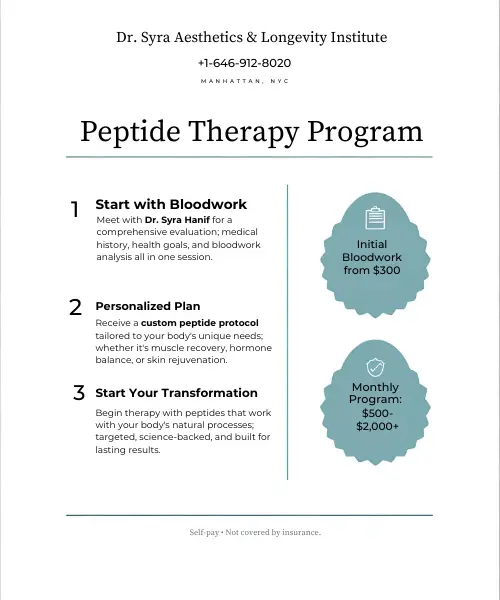
If you are considering peptide-based weight-loss treatment in Manhattan, look for a clinic that provides medical evaluation, prescription management, and ongoing monitoring rather than simply selling peptide products.
At Dr. Syra Aesthetics & Longevity Institute in Manhattan, NYC, weight-management treatment is physician-guided and personalized to each patient. Your consultation includes a review of your medical history, current medications, weight-loss goals, existing health conditions, and potential contraindications to determine whether a prescription option such as semaglutide or tirzepatide may be appropriate.
When necessary, laboratory testing may also be recommended to better understand your metabolic health and establish a safe treatment plan. Progress can then be monitored over time, with treatment adjusted according to your response, tolerance, and long-term weight-management goals.
Because FDA-approved weight-loss medications require a prescription, avoid purchasing peptides from unverified online vendors or sources that do not provide proper medical screening and follow-up.
If you are looking for physician-guided peptide therapy for weight loss in Manhattan, you can schedule a consultation with Dr. Syra Hanif to discuss your eligibility and available treatment options.
What questions to ask your peptide doctor?
Before starting peptide therapy, patients should go into the consultation prepared with key questions.
Here are the most important ones to consider:
- Which peptides are FDA-approved and appropriate for me?
Confirm whether you are being offered a proven prescription option (such as semaglutide, liraglutide, or tirzepatide) rather than an unapproved clinic-marketed peptide. - What side effects should I expect?
Ask about common gastrointestinal issues (nausea, vomiting, diarrhea) and rarer risks like gallbladder disease or pancreatitis (FDA Wegovy prescribing information). - How long would I need to stay on this medication?
Clinical studies show that stopping GLP-1 therapy often leads to weight regain (STEP 4 trial on semaglutide withdrawal), so it’s important to understand the long-term plan. - What will this cost, and is it covered by insurance?
These medications can be expensive; coverage varies by insurance plan and provider. - Can peptide therapy be combined with other weight-management strategies?
Ask how diet, exercise, or behavioral support will be integrated alongside medication for the best long-term results.
Frequently Asked Questions
Can you take CJC-1295 or Ipamorelin with tirzepatide or semaglutide?
Some clinics offer these combinations, but no controlled human trials show that adding growth-hormone peptides (like CJC-1295 or Ipamorelin) to a GLP-1 or GIP/GLP-1 medication improves weight loss. The proven weight-loss effect comes from the FDA-approved incretin drug itself. Combining hormone-active compounds also adds complexity and potential risk, so it should only ever be considered under direct medical supervision — never self-directed from online dosing protocols.
Are Peptides Safe?
The most common side effects are gastrointestinal issues, including nausea, vomiting, diarrhea, and constipation. In most cases, these symptoms are mild to moderate and improve over time, but they can be severe enough for some patients to discontinue treatment (semaglutide STEP 1 trial results).
There are also rarer risks. GLP-1 drugs have been linked to increased risk of gallbladder disease, and they carry warnings about possible associations with pancreatitis. Animal studies have suggested a potential link to thyroid tumors, though this has not been proven in humans (FDA prescribing information for Wegovy). For this reason, people with a personal or family history of certain thyroid cancers are advised not to use these medications.
Do Peptides Cause Muscle Loss Along With Fat Loss?
Yes. Clinical studies show that while GLP-1 peptides like semaglutide and tirzepatide primarily reduce fat mass, some lean muscle is lost as well. This is a common effect of rapid weight reduction, regardless of method. To help preserve muscle, patients are advised to combine peptide therapy with resistance training and adequate protein intake (STEP 1 body composition analysis).
Can Peptides Be Stacked Together for Better Results?
No clinical evidence supports “stacking” peptides for weight loss. Combinations such as CJC-1295 with Ipamorelin are marketed by some clinics, but they have not been proven effective in controlled human studies. FDA-approved peptides like semaglutide or tirzepatide are designed to be used individually under medical supervision.
Are Compounded Peptides Safe to Use Instead of Brand-Name Medications?
Compounded peptides are sometimes offered when branded medications are expensive or in short supply, but the FDA has warned that compounded semaglutide and tirzepatide may not meet the same safety or quality standards as FDA-approved products (FDA statement on compounded semaglutide). Patients should verify whether their clinic dispenses approved drugs or compounded alternatives.
What Happens If I Stop Peptide Therapy Suddenly?
Discontinuing peptide therapy often leads to weight regain. In the STEP 4 trial, participants who stopped semaglutide regained about two-thirds of the weight they had lost within one year (STEP 4 withdrawal study). This shows that peptides are most effective when part of a long-term plan, ideally supported by lifestyle changes.
Is It Safe to Buy Peptides Online Without a Prescription?
No. The FDA has issued multiple warnings that peptides sold online as “research chemicals” may be contaminated, mislabeled, or entirely unsafe. Legitimate peptide therapy for weight loss should always come from an FDA-approved medication prescribed by a licensed healthcare provider (FDA guidance on unapproved drugs).

Written & Medically Reviewed by
Dr. Syra Hanif, M.D.
Board-Certified Primary Care Physician
Dr. Syra Hanif, M.D., is a board-certified physician specializing in aesthetic medicine, longevity, and preventative wellness. As Medical Director of Dr. Syra Aesthetics & Longevity Institute in NYC, she focuses on aesthetics, healthy aging, and overall wellness.
Read More