



Masseter Botox, also known as jawline Botox or jaw reduction Botox, is a procedure that includes injecting botulinum toxin into the masseter muscles in the jawline. This treatment intends to relax and weaken these muscles, causing them to shrink in size and prominence.
Botox injections for masseter muscles have grown popular for cosmetic and medical treatment options. While it was primarily used to treat jaw clenching and teeth grinding (bruxism), its cosmetic benefits to achieve a more balanced and youthful facial appearance have now gained massive attention.
Masseter Botox has gained popularity for effectively addressing two key concerns: therapeutic alleviation and cosmetic enhancements.
From a therapeutic aspect, it provides a solution for people who suffer from bruxism i.e. a condition characterized by unconscious teeth grinding and jaw clenching. Active muscle activity is reduced by injecting Botox into the masseter muscles, relieving the discomfort associated with bruxism.
When it comes to aesthetic benefits – it targets the masseter muscles responsible for a squared jawline, for people who want a more balanced facial appearance. Masseter Botox helps in achieving a V-shaped facial contour by regulating the weakening of these muscles.
1. Bruxism Relief: Masseter Botox is an excellent treatment for people suffering from bruxism. Botox injections into the masseter muscles lower their activity, relieving bruxism symptoms.
2. Beauty Enhancement: In addition to its medicinal applications, masseter Botox is sought for its beauty advantages. Overdeveloped masseter muscles may cause a squaring of the jawline. By reducing the size and prominence of the masseter muscles, Botox can assist in generating a more balanced and V-shaped face.
How Many Units For Masseter Botox?
The average number of units for masseter Botox is 20–30 units per side (40–60 units total), as the masseter muscle generates high bite force and requires adequate weakening to reduce activity while maintaining mastication. When the masseter muscle is larger or hypertrophic, dosing increases to 30–40 units per side (60–80 units total) to account for greater muscle volume and contraction strength.
For patients seeking cosmetic jaw slimming without functional symptoms, dosing is 20–25 units per side (40–50 units total), which allows reduction in muscle bulk while preserving normal chewing. In cases of TMJ disorder or bruxism, dosing commonly ranges from 25–40 units per side (50–80 units total), as symptom relief depends on reducing sustained clenching force and muscle overactivity.
Patient Type | Units Per Side | Total Units (Bilateral) | Primary Goal |
First-Time / Naïve | 15–20 Units | 30–40 Units | Baseline response |
Cosmetic Jaw Slimming | 20–25 Units | 40–50 Units | Jawline contouring |
Standard TMJ / Bruxism | 25–40 Units | 50–80 Units | Muscle relaxation |
Severe Hypertrophy (Selected Cases) | 35–45 Units | 70–90 Units | Functional relief |
At Dr. Syra Aesthetics and Longevity Institute, Masseter Botox dosing is individualized rather than fixed. Dr. Syra Hanif evaluates masseter muscle size, symmetry, and functional activity to determine the appropriate per-side dosing, ensuring effective muscle relaxation while preserving normal mastication.
How Many Units For Masseter Botox Per Side?
Masseter Botox is dosed 20–30 units per side, which equals 40–60 units total. Clarifying this distinction is important, as treatment is administered bilaterally and unit recommendations are commonly discussed on a per-muscle basis.
For patients with larger or hypertrophic masseter muscles, dosing often increases to 30–40 units per side (60–80 units total) to adequately weaken the stronger jaw muscle. For average cosmetic jaw slimming, the usual dose is 20–25 units per side (40–50 units total), sufficient to reduce lower-face width without affecting chewing. When botulinum toxin is used for TMJ dysfunction or bruxism, dosing commonly ranges from 25–40 units per side (50–80 units total), as therapeutic outcomes depend on reducing clenching force and sustained muscle activity.
How Many Units For Masseter Botox For a First Time Patient?
For a first-time patient, masseter Botox is started at a lower initial dose of 15–20 units per side (30–40 units total). This approach is used to assess individual muscle response, avoid excessive weakening, and preserve normal chewing function.
After 2–4 weeks, the treatment response is reassessed. If muscle reduction, jaw contour change, or symptom relief is insufficient, the dose can be adjusted upward in a controlled manner. Subsequent treatments commonly increase toward standard dosing ranges of 20–30 units per side, depending on muscle size, symmetry, and treatment goals.
This start-low, reassess, and adjust strategy allows for safe titration, minimizes adverse effects such as chewing fatigue, and provides individualized dosing over time.
How Many Units For Masseter Botox For Bruxism?
For bruxism, masseter botulinum toxin is dosed at 25–40 units per side (50–80 units total). This dose range is used because effective bruxism management requires a meaningful reduction in clenching force and sustained masseter muscle activity rather than cosmetic muscle thinning alone.
In first-time bruxism patients, treatment often starts at 20–25 units per side, followed by reassessment after 2–4 weeks. If jaw pain, muscle fatigue, or nocturnal clenching persists, the dose is adjusted upward in subsequent sessions. This stepwise approach helps control symptoms while maintaining functional chewing.
Where Do You Inject Masseter Botox?
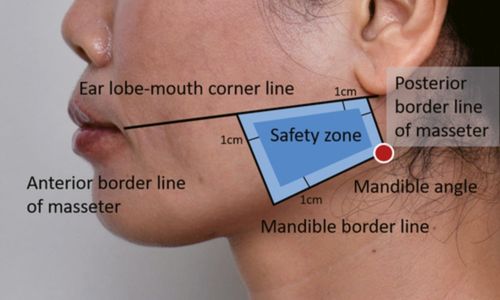
Masseter Botox is injected into the belly of the masseter muscle, located at the angle of the mandible. The muscle is identified by asking the patient to clench, allowing the injector to palpate the thickest portion of the muscle.
Injection placement remains posterior to the oral commissure and avoids the upper masseter to reduce diffusion into nearby facial expression muscles. Proper depth and placement are essential to achieve effective muscle weakening and minimize adverse effects.
What Are The Factors That Influence Masseter Botox?
While multiple factors influence Masseter Botox dosing, muscle size, functional activity, and treatment intent are the primary determinants. Demographic factors such as gender, age, and body weight play a secondary role and do not replace individualized anatomical assessment.
Gender
Gender influences average masseter muscle volume and bite force. Male patients often have larger and stronger masseter muscles, which may require higher dosing compared to female patients, although dosing is always individualized rather than gender-based alone.
Age
Age affects muscle tone and facial structure. Younger patients often have higher muscle activity and may require higher or more frequent dosing, while older patients may need lower doses due to reduced muscle strength or concurrent facial volume loss.
Body Weight (Light Influence)
Body weight has a limited effect on masseter dosing. While higher body mass can correlate with overall muscle size, masseter hypertrophy is more strongly related to functional use (clenching and grinding) than total body weight.
Muscle Size
Muscle size is one of the most important determinants of dosing. Thicker or hypertrophic masseters require more units to achieve adequate neuromuscular weakening, while smaller muscles respond to lower doses.
Functional vs Cosmetic Intent
Treatment goals significantly influence dosing. Functional indications such as bruxism or TMJ disorders require higher doses to reduce bite force, whereas cosmetic jaw slimming uses lower doses focused on contour reduction.
Bruxism Severity
Severity of bruxism directly impacts dose selection. Patients with severe clenching, jaw pain, or dental wear often require higher unit counts and may need treatment of additional muscles beyond the masseter.
First-Time vs Maintenance Treatment
First-time patients are usually treated with conservative dosing to assess response and tolerance. Maintenance treatments often involve adjusted or reduced doses once muscle atrophy has occurred.
Injector Technique
Injection depth, number of injection points, dilution, and anatomical precision affect clinical outcomes. Proper placement within the lower masseter muscle belly ensures effective treatment while minimizing adverse effects such as diffusion or asymmetry.
What Happens During The Appointment?
During the appointment, the provider reviews medical history, confirms the treatment goal, and examines the jaw muscles at rest and during clenching to assess masseter size and activity. The injection sites are identified by palpation, the skin is cleansed, and botulinum toxin is injected into the lower portion of the masseter muscle using several small injection points on each side. The procedure is brief and completed within a few minutes. At Dr. Syra Aesthetics and Longevity Institute, Masseter Botox treatments are performed by Dr. Syra Hanif, with dosing and placement guided by individualized anatomical and functional assessment.
After the treatment, patients can resume normal daily activities immediately, with minimal restrictions. Mild tenderness or swelling at the injection sites may occur and usually resolve within a short period. The effects develop gradually over several days, with reduction in muscle activity becoming noticeable within one to two weeks and full results apparent by three to four weeks.
Masseter Botox Before and After
Functional and cosmetic outcomes follow different timelines. Patients treated for bruxism or TMJ symptoms often notice reduced jaw tension and clenching within 1–2 weeks, while cosmetic jaw slimming develops gradually over 3–6 weeks as muscle activity decreases.
Results vary based on baseline muscle size, dose, and treatment frequency. With repeated treatments, progressive muscle atrophy may lead to longer-lasting effects and reduced dosing requirements over time.
How To Find The Right Masseter Botox Provider In Manhattan, NYC?
- Clarify your goal first: Know whether you want Masseter Botox for bruxism/TMJ relief or cosmetic jaw slimming, as this determines the type of provider and dosing approach you need.
- Prioritize medical training and oversight: Choose a physician-led or medically supervised provider with formal training in facial and jaw anatomy, as masseter injections involve deeper, functional muscles.
- Look for masseter-specific experience: The provider should routinely perform masseter Botox, not just standard cosmetic Botox for the forehead or crow’s feet.
- Avoid choosing based on price alone: Unusually low pricing may reflect limited experience, product dilution, or suboptimal injection technique.
- Expect a hands-on jaw assessment: A qualified provider should palpate the masseter during clenching and assess muscle size, symmetry, and function before recommending a dose.
- Check reviews for jaw-related outcomes: Focus on feedback mentioning TMJ relief, reduced clenching, chewing comfort, or jawline balance, rather than generic Botox reviews.
- Confirm follow-up availability: The right provider offers reassessment and dose adjustment if results are insufficient or asymmetrical.
Among all variables, masseter muscle size and functional activity remain the most reliable predictors of dosing requirements. Patients seeking Masseter Botox in Manhattan often look for physician-led care, precise dosing, and experience with both cosmetic and functional indications. Dr. Syra Aesthetics and Longevity Institute, led by Dr. Syra Hanif, provides Masseter Botox treatments grounded in anatomical expertise and individualized treatment planning.
How Many Units Are Recommended For Masseter By Different Brands?
Masseter Botox dosing varies by product because units are not interchangeable. Dysport requires a higher numeric dose, while Jeuveau and Xeomin are dosed similarly to Botox. In all cases, dosing is calculated per side and adjusted based on masseter size and whether the treatment goal is cosmetic slimming or functional relief.
Dysport is dosed at 50–75 units per side (100–150 units total), reflecting its higher unit conversion compared to other neuromodulators.
Jeuveau is commonly administered at 20–30 units per side (40–60 units total), as its unit potency aligns closely with Botox.
Xeomin is also dosed at 20–30 units per side (40–60 units total), with dosing based on muscle size and treatment intent rather than formulation differences.
How Many Units Of Dysport Are Needed For Masseter?
For masseter treatment, Dysport is dosed at 50–75 units per side (100–150 units total). Dysport units are not interchangeable with Botox units and generally require a higher numeric dose due to different potency and diffusion characteristics. Dosing is adjusted based on muscle size and functional needs such as bruxism.
How Many Units Of Jeuveau Are Needed For Masseters?
Jeuveau dosing for the masseter usually mirrors Botox, at 20–30 units per side (40–60 units total). Jeuveau has a similar unit-to-unit potency to Botox, making conversion straightforward. Higher doses may be used for hypertrophic muscles or functional indications.
How Many Units Of Xeomin Are Needed For Masseter?
Xeomin is also dosed similarly to Botox, with dosing at 20–30 units per side (40–60 units total). Because Xeomin contains only the active neurotoxin without accessory proteins, dosing is based on muscle size and treatment intent rather than brand-specific adjustments.
How Much Does Masseter Botox Cost in NYC?
The cost of Botox in NYC for masseter muscle ranges from $800 to $2,000 per treatment, depending on total units used, pricing model, and injector expertise. Pricing is often higher in Manhattan medical practices due to provider specialization and clinic overhead. Costs may also vary between physician-led medical offices and aesthetic-only clinics, as well as by the brand of botulinum toxin used. At Dr. Syra Aesthetics and Longevity Institute, pricing is discussed during consultation and based on the number of units required for each patient’s anatomy and treatment goals.
How Often Do You Need Masseter Botox Treatment?
Masseter botulinum toxin treatments are needed every 3–6 months. The duration depends on individual muscle activity, treatment dose, and whether the indication is cosmetic jaw slimming or functional relief such as bruxism.
For first-time patients, effects often last closer to 3–4 months, as the masseter muscle has not yet undergone atrophy. With maintenance treatments, muscle size and strength gradually decrease, and many patients are able to extend treatment intervals to 4–6 months. Patients treated for severe bruxism may require more frequent sessions, while those treated for cosmetic contouring may maintain results with fewer treatments over time.
What Are The Side Effects Of Masseter Botox?
- Mild pain, tenderness, or swelling at the injection sites
- Temporary chewing fatigue, especially with hard or chewy foods
- Jaw weakness during the first one to two weeks
- Headache or jaw soreness shortly after treatment
- Temporary facial asymmetry if dosing or placement is uneven
- Changes in smile if the toxin diffuses into adjacent muscles
- Rare bruising at injection sites
Is Masseter Botox Painful?
Masseter Botox is generally well tolerated and causes minimal discomfort for most patients. The injections are performed with a very fine needle, and the sensation is usually described as a brief pinch or pressure rather than pain.
Some patients experience mild soreness or tightness in the jaw for a short time after treatment, especially during chewing, but this resolves within a few days. If needed, topical numbing cream or ice can be used before injections to further improve comfort.

About The Author
Dr. Syra Hanif M.D.
Board Certified Primary Care Physician
Dr. Hanif is the Director of Aesthetic Medicine. She is a board-certified physician in Aesthetic Medicine who specializes in using non-surgical alternatives in order to enhance one's appearance through Botox and fillers.
Read More