


Botox lasts about 3 to 4 months in most cosmetic treatment areas, though certain regions fade sooner or last longer depending on muscle activity, dosage, metabolism, and treatment history. Areas with constant movement like the lips and perioral muscles tend to metabolize Botox more quickly, lasting around 6 to 8 weeks.
High-demand zones such as the masseter can hold results for 4 to 6 months, and medical applications like hyperhidrosis, bladder treatments, and migraine therapy often last even longer due to higher dosing and deeper injection protocols.
Botox longevity is broken down by treatment area, medical condition, and brand differences, giving readers a detailed look at how each zone and purpose responds to neurotoxin therapy. Factors that affect duration include dosing accuracy, injection technique, muscle strength, lifestyle, and frequency of past treatments.
How Long Does Botox Last By Treatment Area?
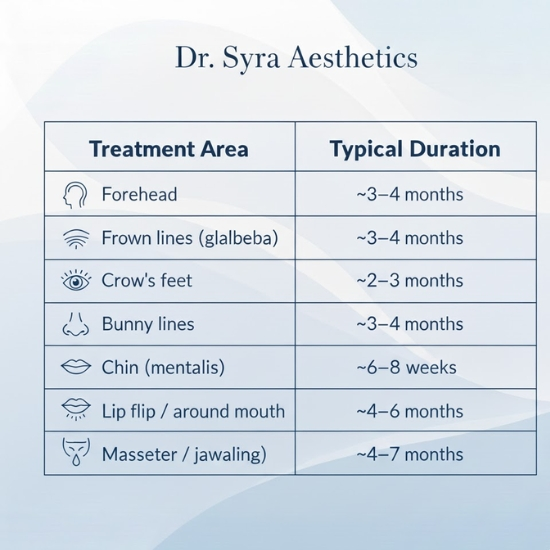
Botox lasts 3 to 4 months in most cosmetic treatment areas, though longevity varies depending on muscle strength and activity levels. Clinical studies show that muscles with higher motion such as the forehead and crow’s feet tend to metabolize botulinum toxin more quickly than lower-activity zones. Research also supports that dosage, technique, and patient anatomy influence longevity across different parts of the face and body.
Because each treatment area responds differently, patients may notice longer results in some regions and shorter results in others. Understanding these variations helps set realistic expectations for how results will fade over time.
Below is a breakdown of how long Botox lasts in each major cosmetic area.
Treatment Area | Typical Duration |
Forehead | ~3–4 months |
Frown lines (glabella) | ~3–4 months |
Crow’s feet | ~3–4 months |
Bunny lines | ~2–3 months |
Chin (mentalis) | ~3–4 months |
Lip flip / around mouth | ~6–8 weeks |
Masseter / jawline | ~4–6 months |
Armpits (sweating) | ~4–7 months |
How Long Does Botox Last in Your Forehead?
Botox in the forehead lasts 3 to 4 months. First-time patients often see 2 to 3 months and repeat patients reach the full 3 to 4 months as the frontalis muscle adapts to treatment. The number of units influences longevity, with higher doses lasting longer and lower doses wearing off sooner, and duration is shaped by muscle strength, metabolism, injection precision, facial movement frequency, and treatment history.
The forehead treatment area (frontalis muscle) affects how long the results hold because stronger or frequently activated muscles break down Botox faster. Results last longer when dosing matches muscle strength, injection points follow the natural muscle pattern, brow support is balanced, and sessions are repeated at consistent intervals.
How Long Does Botox Last in Your Lips?
Botox in the lips (lip flip) lasts 6 to 8 weeks. The orbicularis oris muscle is small and highly active, so it tends to metabolize the product faster than larger facial muscles.
Duration is influenced by:
- Unit count (too few units may wear off quickly)
- Injection accuracy and superficial placement
- How often you talk, smile, and purse your lips
- Treatment history and muscle responsiveness
Because the lips are in constant motion, longevity is naturally shorter here than in areas like the forehead or crow’s feet. Results tend to last longer when units are carefully matched to lip strength, injection points remain superficial, and early post-treatment pressure or excessive puckering is avoided.
How Long Does Botox Last in the Armpits?
Botox in the armpits for sweating (axillary hyperhidrosis) lasts 4 to 6 months, and some patients may experience dryness for up to around 7 months, depending on sweat gland activity and dosing.
Longevity is shaped by:
- Total units used
- Severity of sweating before treatment
- How evenly injections cover the sweat gland area
- Consistent retreatment schedule
The underarm area generally responds very well to Botox because sweat glands remain relatively stable. Results tend to last longer when coverage is uniform, dosing is adequate for sweating severity, and retreatments follow a consistent schedule.
How Long Does Botox Last in Your Chin?
Botox in the chin lasts 3 to 4 months. As the mentalis muscle relaxes and dimpling or orange-peel texture softens. Duration varies with muscle strength, unit count, and how frequently the chin contracts during speech.
The chin treatment area is a compact muscle group, and results last longer when units match muscle tension, injection placement stays precise, and follow-up treatments maintain consistent relaxation of the mentalis.
How Long Does Botox Last in Your Bunny Lines?
Botox for bunny lines lasts 2 to 3 months. The nasalis muscle is small and active, which can cause the product to wear off slightly faster than in larger facial muscles. Duration depends on unit count, injection accuracy, and the intensity of nose scrunching habits.
The bunny line treatment area involves dynamic nasal movement, and longevity improves when dosed accurately, injection sites align with the nasalis, and excessive nose wrinkling is minimized shortly after treatment.
How Long Does Botox Last in the Masseter?
Botox in the masseter lasts 4 to 6 months, with jaw-clenching patients sometimes seeing 3 to 4 months initially and longer durability after repeated treatments as the muscles reduce in strength and size. Unit count strongly determines longevity in this area.
The masseter treatment area consists of large chewing muscles, and results last longer when dosing is appropriate for bruxism severity, injection depth targets the muscle belly, and follow-up treatments are maintained to condition the masseter.
How Long Does Botox Last in the Hands?
Botox in the hands for sweating lasts 4 to 5 months, with duration influenced by dosing, severity of hyperhidrosis, and how active the sweat glands are. Hands require higher unit counts to maintain longer results.
The hand treatment area contains dense sweat gland clusters and constant daily use, and longevity improves when units are evenly distributed, dosing is sufficient for the severity of sweating, and touch-ups follow consistent intervals.
How Long Does Botox Last on Crow’s Feet?
Botox for crow’s feet lasts 3 to 4 months, with first-time patients often seeing 2 to 3 months and repeat patients maintaining results closer to 3 to 4 months as the orbicularis oculi adapts. Duration depends on unit count, muscle activity while smiling, and precision of injection placement.
The crow’s feet treatment area involves rapid, repetitive eye movement, and results last longer when units match muscle strength, injection mapping follows the lateral canthus pattern, and early excessive squinting is avoided.
How Long Does Botox Last in Frown Lines?
Botox in frown lines lasts 3 to 4 months, with first-time patients reaching 2 to 3 months and repeat patients maintaining the full 3 to 4 months as the glabellar complex becomes conditioned. Longevity is influenced by muscle strength, unit count, and how frequently the corrugators activate.
The frown line treatment area involves strong pulling muscles between the brows, and results last longer when dosing is matched to muscle force, injection depth is accurate, and brow-furrowing is minimized early after treatment.
How Long Does Botox Last Around the Mouth?
Botox around the mouth lasts 6 to 8 weeks, as the perioral muscles are highly active and metabolize the product faster than most facial regions. Duration depends on the number of units used, precision of superficial placement, and speech-related muscle activity.
The perioral treatment area involves constant movement from speaking and eating, and longevity improves when dosing remains conservative yet balanced, placement targets specific expression lines, and early excessive puckering or pressure on the area is avoided.
How Long Does Botox Last By Medical Conditions?
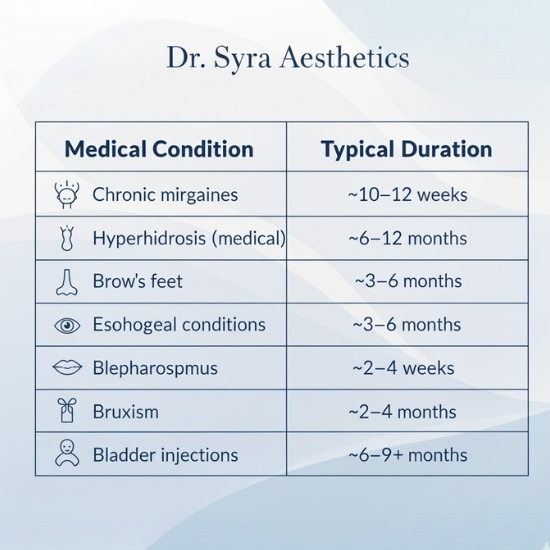
Botox lasts 10 to 12 weeks for most medical conditions, though some patients may experience results lasting up to 3 to 4 months depending on the treated muscle group and symptom severity. Clinical studies show that therapeutic doses used for conditions such as migraines, hyperhidrosis, and muscle spasticity often provide longer-lasting relief compared to cosmetic applications because higher unit strengths and deeper injection patterns are involved.
Medical Botox treatments target overactive muscles or glands, so longevity varies based on how frequently the symptoms return, how the condition responds over repeated sessions, and how quickly the body metabolizes the medication. Understanding these differences helps patients know what to expect from each condition-specific treatment.
Below is a detailed look at how long Botox lasts for each medical condition and how treatment schedules may differ.
Medical Condition | Typical Duration |
Chronic migraines | ~10–12 weeks |
Hyperhidrosis (medical) | ~6–12 months |
Esophageal conditions | ~3–6 months |
Blepharospasm | ~10–12 weeks |
Strabismus | ~2–4 months |
Bruxism | ~4–6 months |
Bladder injections | ~6–9+ months |
How Long Does Botox for Migraines Last?
Botox for migraines lasts around 10 to 12 weeks, with most patients scheduling repeat treatments every 3 months. To effectively reduce migraine frequency and intensity, Botox requires at least 2 to 3 treatment sessions, spaced 12 weeks apart. Results can vary between first-time and repeat patients, with repeat patients often experiencing longer-lasting relief as muscle and nerve activity gradually decrease over time. Longevity depends on factors such as nerve hyperactivity, how often migraines occur, metabolic speed, and individual response to neurotoxin therapy. Treating chronic migraine generally requires a higher dosage 155 to 195 units following a standardized PREEMPT injection protocol, which targets 31 to 39 injection sites across the head, neck, and shoulders.
Factors that affect how long migraine Botox lasts include muscle activity, dosage, frequency of migraine attacks, stress levels, sleep hygiene, medications taken, metabolism rate, and whether the patient adheres to a regular 12-week treatment schedule.
How Long Does Botox for Hyperhidrosis Last?
Botox for hyperhidrosis lasts around 6 to 12 months, with most patients repeating treatments once or twice per year to maintain dryness. To fully control sweating, Botox requires 1 to 2 sessions, spaced at least 6 months apart depending on sweat gland severity. Results may vary between first-time and repeat patients, with repeat users often experiencing longer, more consistent dryness as nerve activity decreases over time. Longevity depends on factors such as sweat gland density, severity of hyperhidrosis, metabolic rate, and nerve regeneration speed. Treating severe sweating usually requires a higher dosage 50 to 100 units per armpit, following an injection grid protocol that targets multiple sweat gland zones to ensure full coverage.
How Long Does Botox for Esophageal Conditions Last?
Botox for esophageal conditions lasts around 3 to 6 months, depending on the severity of muscle tightness and the underlying diagnosis (such as achalasia or esophageal spasm). Most patients require 1 treatment session, though some may benefit from repeat injections every 4 to 6 months to maintain swallowing improvements. Results may vary between first-time and repeat patients, especially in medical conditions where muscle tone patterns differ. Longevity depends on the degree of lower esophageal sphincter dysfunction, disease progression, metabolic rate, and nerve response to neurotoxin therapy. Treating esophageal disorders requires 80 to 100 units, delivered through a guided endoscopic injection protocol into the lower esophageal sphincter.
How Long Does Botox for Blepharospasm Last?
Botox for blepharospasm lasts around 10 to 12 weeks, and patients usually require ongoing treatments every 3 months to maintain symptom control. Most individuals need multiple sessions, as improvement builds over repeated treatments. Results may vary between first-time and long-term patients, with returning patients experiencing smoother, longer-lasting relief. Longevity depends on nerve hyperactivity, severity of eyelid spasms, metabolic rate, and how quickly neuromuscular junctions regenerate. Treating blepharospasm generally requires 25 to 50 units, following a targeted periocular injection pattern around the orbicularis oculi muscle.
How Long Does Botox for Strabismus Last?
Botox for strabismus lasts around 2 to 4 months, with some patients experiencing temporary alignment correction lasting longer depending on muscle response. Treating strabismus often requires 1 to 2 sessions, though complex cases may need repeat treatments every few months. Results may differ for first-time patients, and those with long-standing muscle imbalance may experience variable outcomes. Longevity depends on the strength of the eye muscles, severity of ocular misalignment, nerve activity, and individual healing response. Strabismus treatment usually uses 1 to 5 units per muscle, following a precise injection protocol into selected extraocular muscles.
How Long Does Botox for Bruxism Last?
Botox for bruxism lasts around 4 to 6 months, with many patients scheduling treatments twice per year for optimal jaw relaxation. Effective bruxism management requires 2 to 3 sessions, spaced 3 to 4 months apart, especially during the first year of treatment. Results may vary between first-time and repeat patients, as masseter muscles gradually weaken and shrink with ongoing sessions, extending the longevity of results. Longevity depends on muscle size, nighttime grinding intensity, stress levels, metabolic rate, and chewing habits. Bruxism treatment generally requires 40 to 60 units per side, following a structured masseter injection protocol targeting multiple points in the muscle.
How Long Do Botox Bladder Injections Last?
Botox bladder injections last around 6 to 9 months, with many patients experiencing significant symptom relief for up to 12 months. To manage overactive bladder or urinary urgency, patients need repeat injections every 6 to 9 months, depending on symptom return. Results may vary between first-time and repeat patients, with repeat injections often providing increased longevity as detrusor muscle overactivity decreases over time. Longevity depends on bladder muscle responsiveness, severity of nerve signaling disorders, metabolic rate, and overall bladder health. Botox bladder treatment commonly uses 100 to 200 units, administered through a cystoscopic injection protocol targeting approximately 20–30 sites in the bladder wall.
How Long Does Botox Injections Last by Brand?
Different neuromodulator brands last anywhere from 3 to 9 months, depending on their formulation, active ingredient structure, and peptide technology. Clinical research shows that most botulinum toxin type A products such as Botox, Dysport, Xeomin, Jeuveau, and Letybo deliver results lasting around 3 to 4 months, while newer formulations like Daxxify may last 6 months or longer in many patients.
Each brand has its own diffusion pattern, onset speed, and duration profile, which can influence treatment choice based on patient goals, muscle characteristics, and desired maintenance frequency. Comparing these differences helps patients understand which neuromodulator may fit their needs and how each option behaves over repeated sessions.
The following sections compare Botox to the leading alternative brands and explain how their longevity differs.
How Long Does Botox Last vs Dysport?
Botox lasts around 3 to 4 months, while Dysport also lasts about 3 to 4 months but may begin working slightly sooner. Dysport often diffuses more easily across larger treatment areas, whereas Botox offers more precision for smaller, detailed muscle groups.
When comparing cosmetic zones such as the forehead, crow’s feet, glabella, lips, masseter, and jawline, both injectables provide comparable longevity. Dysport may show earlier visible results and a wider spread making it ideal for broad muscle groups while Botox allows targeted refinement in areas requiring precision. Most patients need repeat sessions every 3 to 4 months, and results may vary between first-time and repeat users, as consistent treatment often leads to longer-lasting effects.
Although both products are botulinum toxin type A, Botox contains onabotulinumtoxinA, while Dysport contains abobotulinumtoxinA, giving each a distinct diffusion profile and potency. Because of these differences, Botox is often preferred for fine-line correction, while Dysport may be chosen for larger areas or when a faster onset is desired.
Factors that influence how long Botox vs Dysport lasts include: dosage, injection technique, muscle strength, facial activity level, metabolic rate, the specific treatment area, and the patient’s treatment history.
How Long Does Botox Last vs Xeomin?
Botox lasts around 3 to 4 months, while Xeomin generally lasts 3 to 4 months as well, though some patients report slightly quicker fading during their first session. Xeomin is formulated without accessory proteins, giving it a “naked” toxin structure that may reduce antibody formation in long-term users while still delivering similar wrinkle-relaxing results.
When comparing cosmetic zones such as the forehead, crow’s feet, glabella, lips, masseter, and jawline, both injectables produce comparable longevity. Xeomin may offer a more natural, gradual softening due to its purified formulation, while Botox provides a well-established balance of precision and predictable spread. Most patients need repeat sessions every 3 to 4 months, and results may differ between first-time and repeat patients, with ongoing treatments often extending the duration of visible improvement.
Although both products are botulinum toxin type A, Botox contains onabotulinumtoxinA, while Xeomin contains incobotulinumtoxinA, which is entirely free of complexing proteins. This difference may make Xeomin appealing for patients concerned about toxin resistance, whereas Botox remains a go-to option for those wanting decades of proven consistency across all facial areas.
Factors that influence how long Botox vs Xeomin lasts include: dosage, injection technique, muscle strength, facial activity level, metabolic rate, the specific treatment area, and the patient’s treatment history.
How Long Does Botox Last vs Jeuveau?
Botox lasts around 3 to 4 months, while Jeuveau often referred to as “Newtox” also lasts about 3 to 5 months, occasionally slightly longer in certain cosmetic areas. Jeuveau is formulated specifically for aesthetic use, making it a strong competitor for patients seeking a modern alternative with similar longevity to Botox.
When comparing cosmetic zones such as the forehead, crow’s feet, glabella, lips, masseter, and jawline, both injectables deliver similar duration. Jeuveau may show a subtle edge in smoothing glabellar lines due to its optimized manufacturing process, while Botox remains the most universally predictable option. Most patients require retreatment every 3 to 4 months, and results may differ between first-time and repeat users, with consistent treatments sometimes prolonging outcomes.
Although both are botulinum toxin type A products, Botox contains onabotulinumtoxinA, while Jeuveau contains prabotulinumtoxinA-xvfs, giving Jeuveau a slightly different purification and diffusion behavior. Jeuveau is often chosen by patients who prefer a contemporary toxin option or who respond particularly well to its aesthetic-focused formulation.
Factors that influence how long Botox vs Jeuveau lasts include: dosage, injection technique, muscle strength, facial activity level, metabolic rate, the specific treatment area, and the patient’s treatment history.
How Long Does Botox Last vs Daxxify?
Botox lasts around 3 to 4 months, while Daxxify stands out with a longer duration of 6 to 9 months for many patients. Daxxify uses a peptide-powered stabilization technology that allows the toxin to bind longer, making it the longest-lasting neuromodulator currently available for cosmetic use.
When comparing cosmetic zones such as the forehead, crow’s feet, glabella, lips, masseter, and jawline, Daxxify generally maintains results longer than Botox. Some areas like the glabella and forehead show particularly extended longevity with Daxxify, while Botox offers steady, reliable outcomes across all zones. Most patients need repeat sessions of Botox every 3 to 4 months, while Daxxify users may need maintenance only twice a year. Results for both may vary between first-time and repeat users, with ongoing treatment often stabilizing expectations.
Although both products are botulinum toxin type A, Botox contains onabotulinumtoxinA, while Daxxify contains daxibotulinumtoxinA-lanm, paired with a proprietary peptide to enhance duration. Because of this, Daxxify is often preferred by patients wanting fewer appointments per year, while Botox remains ideal for those requiring flexibility, precision, or gradual adjustment of results.
How Long Does Botox Last vs Letybo?
Botox lasts around 3 to 4 months, while Letybo, one of the newer botulinum toxin type A options also lasts approximately 3 to 4 months, with some users reporting slightly smoother onset in the glabella region. Letybo is gaining popularity due to its refined particle size and consistent diffusion pattern.
When comparing cosmetic zones such as the forehead, crow’s feet, glabella, lips, masseter, and jawline, both injectables offer similar duration. Letybo may provide particularly soft, natural movement in dynamic areas like crow’s feet, whereas Botox remains the most studied and reliable option across all facial zones. Most patients need repeat sessions every 3 to 4 months, and results may vary between first-time and repeat patients, with longevity improving through consistent treatments.
Although both products are botulinum toxin type A, Botox contains onabotulinumtoxinA, while Letybo contains letibotulinumtoxinA, a formulation recognized for its balance of precision and spread. Letybo may appeal to patients who respond well to its smooth, consistent injection profile or who prefer modern alternatives to traditional brands.
Factors That Affect How Long Botox Injections Last
These factors influence how long Botox lasts in each treatment area, for different medical conditions, and across all brands.
Dosage and Injection Technique
The dosage used and the injector’s technique play a major role in how long Botox results last. Higher units generally offer longer-lasting relaxation, especially in stronger muscles such as the glabella, forehead, and masseter. However, the dosage must be carefully balanced to maintain natural expression. A skilled injector determines the appropriate units based on muscle strength, symmetry, and the aesthetic outcome you want.
Injection technique also significantly influences duration. Precise needle placement, accurate depth, and an understanding of facial anatomy ensure Botox reaches the targeted muscle fibers evenly. When injections are delivered with correct mapping and consistent coverage, the results often last longer and fade more gradually. Conversely, poorly distributed injections or insufficient units may wear off faster than average.
Frequency of Treatments
The frequency of Botox treatments directly impacts how long your results last over time. Most patients schedule treatments every 3 to 4 months, but repeated, consistent sessions may “train” the muscles to stay relaxed longer. As the muscle becomes less active with ongoing treatments, Botox may begin lasting slightly longer, sometimes stretching closer to 4 to 5 months for experienced users.
First-time patients may notice Botox wearing off a bit sooner because their muscles are stronger and more reactive. Over several sessions, the muscle activity gradually diminishes, allowing results to stabilize and become more predictable. Maintaining a consistent treatment schedule prevents the muscle from fully regaining its strength, supporting longer-lasting and smoother outcomes.
Metabolism & Activity Level
A patient’s metabolism and activity level can significantly affect how long Botox lasts. Individuals with faster metabolic rates may break down neuromodulators more quickly, leading to shorter duration—often closer to the lower end of the 2–4 month range. Similarly, those who engage in intense workouts, high-energy activities, or have active facial expressions may experience faster wear-off due to increased muscle movement.
Lifestyle factors such as stress levels, sleep quality, and overall health can also influence metabolic speed and, in turn, Botox longevity. Meanwhile, patients with slower metabolisms or lower muscle activity often enjoy longer-lasting results. Because these factors vary from person to person, Botox duration can differ significantly even when dosage and technique remain consistent.
Medical Disclaimer
This article is for general educational purposes only and does not replace medical advice, diagnosis, or treatment. Botox is a prescription medication and should only be injected by qualified, licensed professionals. Always consult your healthcare provider about whether Botox is appropriate for you, what dose you need, and how long it is likely to last in your specific case.
Does Botox Last Forever?
No, Botox does not last forever, and its effects last about 3 to 4 months on average for most cosmetic treatment areas. While some patients may experience slightly shorter or longer results depending on the area treated, Botox always wears off because the body gradually breaks down the neurotoxin and restores natural nerve-to-muscle communication.
How long does Botox take to wear off?
Botox takes about 3 to 4 months to wear off for most cosmetic areas, though some patients may notice movement returning as early as 2 months or as late as 5 months. The fading process is gradual: results begin softening around weeks 8–10 as the body metabolizes the medication and nerve signals start reconnecting with the treated muscles. Factors like dosage, muscle strength, facial activity level, and metabolism influence how quickly Botox wears off.
Does Botox last longer the second time?
Yes, Botox often lasts longer the second time, though this varies by patient. After the first treatment, the muscles are stronger and may metabolize the neurotoxin faster, resulting in a slightly shorter duration. With repeated treatments spaced every 3 to 4 months, the targeted muscles become less active over time, which can help the results last closer to the upper end of the typical range. Consistency, proper dosage, and muscle conditioning all play a role in extending longevity with ongoing sessions.
How long does Botox take to heal?
Botox generally takes 1 to 2 days to heal, with most mild side effects—such as redness, tiny bumps, or light swelling resolving within minutes to a few hours. Full settling of the treatment occurs over 1 to 2 weeks as the product binds to the muscle receptors and begins relaxing movement. Healing time may vary depending on injection technique, skin sensitivity, hydration, post-treatment care, and how quickly your body recovers from minor needle entry points.
Is Botox permanent?
No, Botox is not permanent, and the effects last about 3 to 4 months on average for cosmetic areas. The body naturally breaks down the neurotoxin over time, allowing nerve signals to recover and muscle activity to return. Botox cannot provide permanent wrinkle reduction because your muscles continually regenerate nerve endings, your metabolism clears the toxin, and facial movement gradually reactivates once the effects fade.

About The Author
Dr. Syra Hanif M.D.
Board Certified Primary Care Physician
Dr. Hanif is the Director of Aesthetic Medicine. She is a board-certified physician in Aesthetic Medicine who specializes in using non-surgical alternatives in order to enhance one's appearance through Botox and fillers.
Read More