




Semaglutide starts acting after the first dose, but appetite changes often become noticeable during the first days or weeks, while measurable weight loss develops over several weeks. More substantial weight reduction generally takes several months. The timeline depends on the prescribed dose, individual response, eating habits, and treatment consistency.
How Long Does Semaglutide Take to Start Working?
Injectable semaglutide reaches peak blood concentrations within approximately 1–3 days, but its weight-loss effects develop more gradually. Semaglutide is a GLP-1 receptor agonist, meaning it acts on receptors involved in appetite, feelings of fullness, and blood sugar regulation. By reducing hunger and helping patients feel satisfied after smaller portions, the medication supports lower calorie intake over time. It does not produce an immediate, predictable reduction in body fat after the first injection.
After repeated weekly injections, semaglutide reaches relatively stable blood levels in approximately 4–5 weeks at a constant dose. This is called steady state, and it is not the same as maximum weight loss. Some patients experience early appetite changes while others notice a gradual shift as the dose increases. The table distinguishes medication exposure from outcomes a patient notices.
| Effect | General timeline |
|---|---|
| Peak blood concentration | 1–3 days after injection |
| Appetite changes | Sometimes within days or weeks; variable |
| Steady blood concentration | About 4–5 weeks at the same weekly dose |
| Early weight changes | Often measurable over the first several weeks |
| Substantial weight reduction | Usually develops across several months |
Semaglutide Weight Loss Timeline: Week by Week
Semaglutide treatment moves from a low starting dose through gradual increases to longer-term treatment. The commonly used Wegovy 2.4 mg injection schedule begins at 0.25 mg once weekly. It increases in stages to improve tolerability. Patients do not need to experience the same appetite or weight change at each stage, and results are not guaranteed by a particular week.
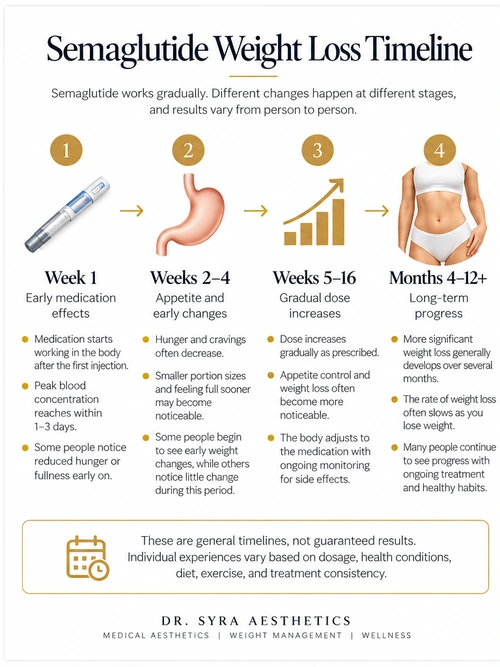
General phases of treatment, not guaranteed individual outcomes.
Week 1: Initial Semaglutide Effects
During the first week, the medication enters circulation and begins affecting appetite and blood sugar regulation. Some patients report smaller meal portions, less interest in snacks, or earlier fullness. Others feel no obvious change, particularly while receiving the standard 0.25 mg initiation dose. Both experiences are possible, and neither establishes how much weight a person eventually loses. Fluctuations in fluid balance and the amount of food in the digestive tract also affect early scale readings.
Weeks 2–4: Early Appetite and Weight Changes
During weeks 2–4, patients following the standard injection schedule remain at 0.25 mg once weekly. Repeated injections gradually increase medication exposure, and hunger or cravings can become less intense for some patients. Early changes in portion size can begin supporting weight reduction, although some people see little difference on the scale during this stage. Four weeks without major weight loss does not, by itself, establish medication failure because the patient remains in treatment initiation.
Weeks 5–16: Dose Escalation and Weight Loss
Weeks 5–16 are the principal dose-increase period in the standard Wegovy 2.4 mg injection regimen. Each stage lasts four weeks, allowing clinicians to review gastrointestinal symptoms and treatment progress. A higher dose changes medication exposure but does not guarantee a faster rate of weight loss. Patients with significant nausea, vomiting, or other adverse effects can require a longer period before the next prescribed increase.
| Weeks | Standard weekly injection dose |
|---|---|
| 1–4 | 0.25 mg |
| 5–8 | 0.5 mg |
| 9–12 | 1.0 mg |
| 13–16 | 1.7 mg |
| 17 onward | 2.4 mg in the standard maintenance schedule |
This schedule describes one injection regimen, not every approved semaglutide formulation. Current US labeling also includes tablets and a higher-dose Wegovy injection option, each with distinct directions. Other prescription weight loss injections use their own dosing schedules, so results cannot be compared based on treatment week alone.
Months 4–12 and Beyond: Long-Term Results
As treatment continues, appetite-related changes and lower calorie intake contribute to weight reduction over months. Weight loss often slows after an initial period because a smaller body typically uses less energy. Stable weight is not automatically evidence that the medication no longer works: maintaining earlier weight loss is itself an important long-term outcome. Continuation, adherence, dietary habits, and clinical follow-up help determine how progress develops.
How Long Does Semaglutide Take to Suppress Appetite?
Semaglutide can reduce hunger in the first days or weeks, but there is no fixed onset day for appetite suppression. The medication acts on GLP-1 receptors involved in hunger and fullness, helping some patients feel satisfied after smaller meals or think about food less frequently. Appetite suppression does not mean never feeling hungry, and a lack of dramatic first-week changes does not automatically mean the medication is ineffective.
A randomized study involving 30 adults with obesity finds approximately 24% lower energy intake across measured meals after 12 weeks of semaglutide treatment compared with placebo. Participants also report less hunger and fewer cravings. The finding explains why reduced food intake supports gradual weight loss, but it does not establish that every patient eats 24% less or feels a change within 24 hours. Whether treatment works is best interpreted through weight trends, medication history, and overall health rather than appetite sensations alone.
How Much Weight Can You Lose on Semaglutide?
In a major trial of adults with overweight or obesity without diabetes, semaglutide 2.4 mg produces an average 14.9% reduction in starting body weight over 68 weeks. The STEP 1 study includes 1,961 participants and compares semaglutide with placebo alongside lifestyle intervention. The placebo group loses an average 2.4% during the same period. These are group averages, not guaranteed results for an individual patient.
The following examples translate percentages into pounds at different starting weights. They illustrate the calculation and do not predict how much a person loses at a specific month.
| Starting weight | 5% loss | 10% loss | 15% loss |
|---|---|---|---|
| 150 lb | 7.5 lb | 15 lb | 22.5 lb |
| 200 lb | 10 lb | 20 lb | 30 lb |
| 250 lb | 12.5 lb | 25 lb | 37.5 lb |
| 300 lb | 15 lb | 30 lb | 45 lb |
The STEP 2 study reports a lower average reduction of 9.6% over 68 weeks in adults with overweight or obesity and type 2 diabetes receiving 2.4 mg semaglutide. The studies involve different populations, so the figures do not predict an individual’s outcome based on diabetes status alone. Starting weight, other health conditions, tolerability, and the actual prescribed treatment help determine realistic goals.
Physician-led consultations assess medical history and suitability. Medication is prescribed only when clinically appropriate.
What Are The Factors Affecting How Long Semaglutide Takes to Work?
Five important factors shape the observed semaglutide response: dose progression, individual health, eating and activity patterns, consistent administration, and medication tolerability. These do not all change when the drug begins acting. Instead, some change drug exposure while others affect how quickly weight-loss results become measurable.

Semaglutide Starting Dose and Dose Escalation
The usual 0.25 mg weekly starting dose introduces the medication gradually. Later scheduled doses increase drug exposure as the clinician monitors appetite, weight, and tolerability. Some patients notice early hunger changes at the starting dose, while others experience more obvious changes later. Dose increases are not a safe shortcut to faster weight loss, and patients follow the exact regimen prescribed for their specific formulation.
Individual Response to Semaglutide
Starting weight, BMI, diabetes status, medications, and other health conditions influence treatment assessment. Two people taking the same dose can lose different percentages of body weight. The weight loss medication eligibility criteria also involve medical history and weight-related conditions, which determine whether prescription treatment is suitable in the first place. Weight reduction is best measured against an individual’s starting weight rather than another person’s results.
Diet and Exercise During Semaglutide Treatment
Semaglutide helps reduce energy intake by influencing hunger and fullness, but meal patterns and activity still affect body weight. Smaller portions do not always mean adequate nutrition; protein, fiber, fluids, and overall dietary quality remain important. Regular walking and resistance exercise support fitness and muscle preservation during weight loss. The strongest clinical trial findings come from medication combined with structured lifestyle advice rather than medication alone.
Semaglutide Dosage Consistency and Missed Doses
Semaglutide injections are generally taken once weekly, and its approximately one-week half-life means the medication remains in circulation between doses. Repeated missed doses or prolonged gaps disrupt the planned treatment course and complicate evaluation. Missed-dose and restart instructions depend on the particular product, so patients follow the label and prescriber’s advice instead of doubling doses or independently returning to a previously tolerated higher dose.
Semaglutide Side Effects and Dose Tolerability
Nausea, vomiting, constipation, and diarrhea can make dose escalation more difficult. A patient with repeated vomiting can also have difficulty maintaining hydration and nutrition. Persistent symptoms need clinical assessment, and clinicians sometimes extend an escalation stage when tolerability is poor. The discussion of long-term side effects of semaglutide explains additional safety concerns, while the response-timeline article remains focused on treatment progress.
Why Is Semaglutide Not Working for Weight Loss?
Limited early weight loss can reflect ongoing dose escalation, individual response differences, inconsistent dosing, or other influences on calorie intake and metabolic health. No single scale reading establishes treatment failure. The duration of treatment, formulation, actual dose, weight trend, and symptoms all influence what an appropriate reassessment involves.
DR. SYRA AESTHETICS
Dr. Syra Hanif, M.D., evaluates weight-loss
progress, medication tolerance, and metabolic
health to identify appropriate next steps.
No Weight Loss After 4 Weeks on Semaglutide
Four weeks is still the initiation phase for the standard weekly injection regimen. Patients usually receive 0.25 mg throughout this period, so the result does not reflect sustained maintenance treatment. Some notice appetite changes before a clear reduction in weight. A meaningful assessment compares repeated measurements under similar conditions and considers changes in eating patterns and tolerability rather than drawing conclusions from one month alone.
No Weight Loss After 8–12 Weeks on Semaglutide
At weeks 8–12, patients following the usual injection schedule remain at intermediate doses. Limited progress warrants review of missed doses, the actual treatment schedule, diet, weight-related conditions, and other medications. A medical weight loss consultation can examine these variables to identify which next step fits the patient’s circumstances. An eight-week or twelve-week threshold alone does not prove that semaglutide has failed.
Semaglutide Weight Loss Plateau
A weight-loss plateau means the scale stabilizes after an earlier period of reduction. As body weight decreases, energy requirements commonly decrease too, allowing a previously effective eating pattern to produce less additional loss. A plateau differs from never responding to treatment. Persistent stagnation can justify reviewing the weight trend, adherence, current dose, nutrition, activity, and other clinical factors. If medication choice becomes a question, a comparison of GLP-1 medications for weight loss provides relevant context, but changes require physician evaluation.
How Long Does Semaglutide Take to Lower Blood Sugar?
Semaglutide starts influencing blood sugar regulation after treatment begins, while HbA1c changes are usually evaluated over several months. The medication increases insulin release when blood sugar is elevated and reduces inappropriate glucagon secretion. Glucose readings can therefore improve before substantial weight loss develops. HbA1c reflects average blood glucose over approximately two to three months, so it does not change on the same timeline as an individual fasting glucose measurement.
Blood sugar results depend on baseline glucose, concurrent medication, treatment consistency, and diabetes status. Patients taking insulin or sulfonylureas have an increased risk of low blood sugar when these medicines are combined with semaglutide. This is one reason glucose monitoring and medication review matter in physician-supervised care.
When to Consult a Doctor About Semaglutide Results
A clinician evaluates persistent limited progress, troublesome side effects, or difficulty following a prescribed semaglutide schedule. Weight history, BMI, diabetes or other metabolic conditions, medication use, nutrition, and tolerability help distinguish early treatment variation from a response requiring further assessment. Significant or persistent vomiting, dehydration, or severe abdominal pain needs prompt medical attention rather than a routine progress visit.
At Dr. Syra Aesthetics in Manhattan, board-certified family medicine physician Dr. Syra Hanif, M.D. evaluates weight history, metabolic health, prescribed treatments, and changes in body weight. The clinic’s medical weight loss program in NYC includes physician-led assessment and follow-up planning for eligible patients. An evaluation helps determine whether the existing treatment remains appropriate and what changes, if any, need consideration.
Frequently Asked Questions
Does semaglutide work without nausea?
Yes. Nausea is a possible adverse effect, not proof that semaglutide is working. Appetite, glucose, and weight responses can occur without digestive symptoms.
Can semaglutide work without noticeable appetite suppression?
Yes. Some patients do not experience dramatic hunger changes. Measurable weight trends, treatment consistency, and clinical results provide a broader assessment than appetite sensations alone.
Does a higher semaglutide dose work faster?
A higher dose changes medication exposure but does not guarantee faster weight loss. Product-specific dose schedules balance effects and tolerability, and dosage adjustments require clinician guidance.
Does Ozempic work faster than Wegovy?
Both contain semaglutide, but the indications, regimens, and measured outcomes differ. One brand is not universally faster, and separate weight-loss and diabetes studies cannot establish a simple onset comparison.
Can semaglutide lower blood sugar before weight loss?
Yes. Its effects on insulin and glucagon can influence glucose measurements before months of reduced calorie intake produce substantial changes in body weight.
Can semaglutide continue working during a plateau?
Yes. Stable weight does not independently establish that semaglutide has stopped affecting appetite or energy intake. Long-term progress includes maintaining lost weight as well as additional reduction.

Written & Medically Reviewed by
Dr. Syra Hanif, M.D.
Board-Certified Primary Care Physician
Dr. Syra Hanif, M.D., is a board-certified physician specializing in aesthetic medicine, longevity, and preventative wellness. As Medical Director of Dr. Syra Aesthetics & Longevity Institute in NYC, she focuses on aesthetics, healthy aging, and overall wellness.
Read More